
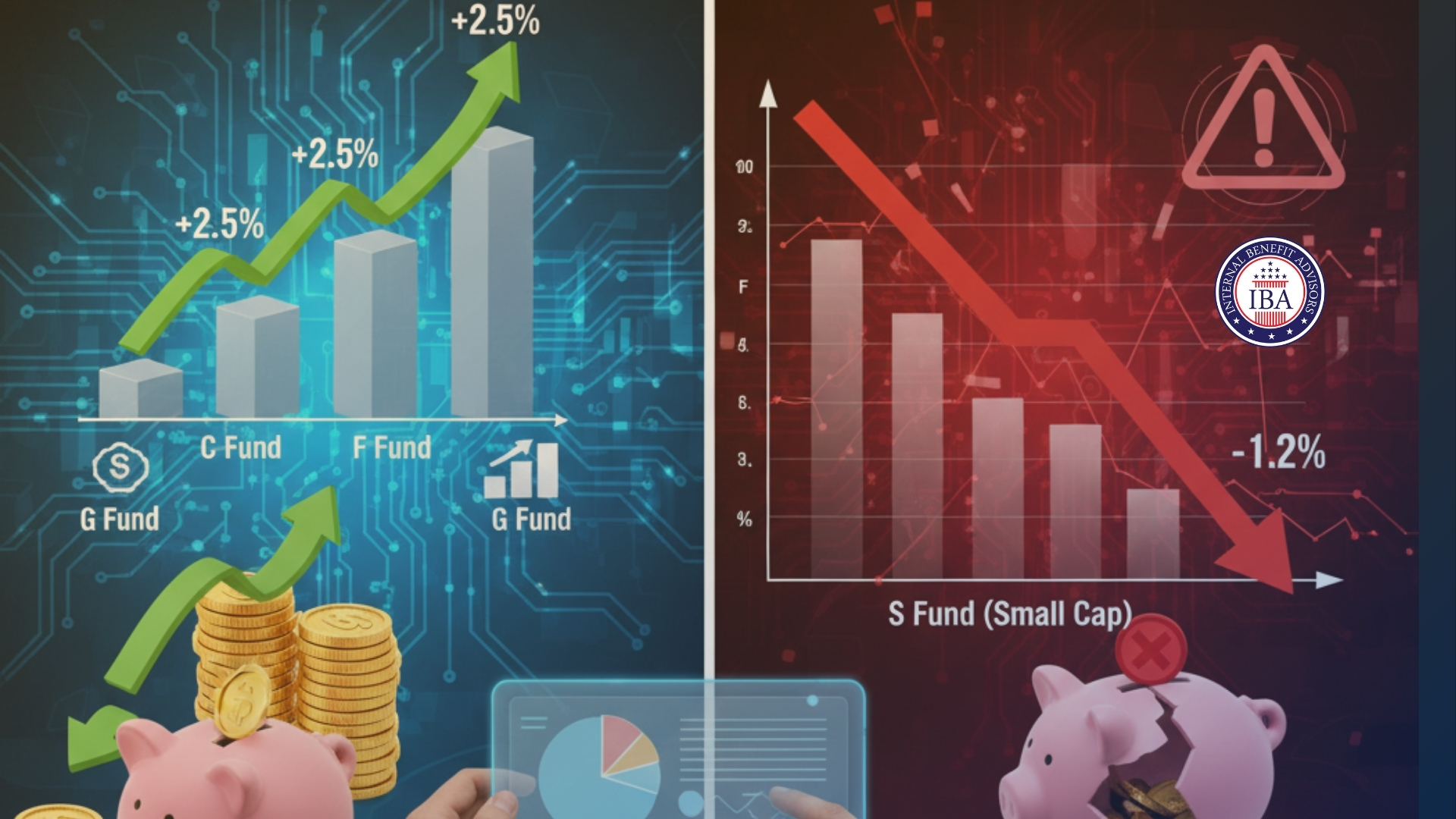

As federal employees and retirees review their November statements, a clear divergence has emerged in the Thrift Savings Plan (TSP). While most funds posted gains, the S Fund (Small Cap Stock Index) slipped into negative territory, highlighting the importance of diversification in your retirement strategy.
According to FEDweek and recent market data, the S Fund was the outlier in a generally positive month. Understanding why this happened—and what it means for your portfolio—is critical for long-term success.
📉 The Numbers: November 2025 Performance
Here is the definitive breakdown of how your funds performed last month:
- S Fund (Small Cap): -0.45% (The only fund to lose value)
- C Fund (Large Cap): +0.24%
- I Fund (International): +0.42%
- F Fund (Fixed Income): +0.64% (The top performer for the month)
- G Fund (Govt. Securities): +0.34%
Year-to-Date Context: Despite the November slip, the S Fund remains up 11.97% for the year. However, it significantly trails the C Fund, which has surged 17.78%, and the I Fund, which leads the pack with a massive 28.54% gain in 2025.
📊 Sound Data: Why Small Caps Stumbled
The slip in the S Fund isn’t random; it reflects specific economic pressures that disproportionately affect smaller companies.
1. “Lack of Conviction” and Volatility: Market analysis from Raymond James indicates that November’s small-cap pullback was driven by a “lack of investor conviction” and leverage concerns. Unlike the tech giants in the C Fund (like Nvidia or Microsoft), smaller companies are perceived as riskier bets when economic signals are mixed.
2. The Interest Rate Sensitivity: Small-cap companies (represented by the S Fund) often rely more heavily on floating-rate debt than the massive corporations in the C Fund. While the Federal Reserve has cut rates, the expectation of future policy is volatile. As noted by Morningstar, rising Treasury yields in late 2025 act as a “roadblock” for small caps, increasing their borrowing costs and dampening investor enthusiasm.
3. Benchmark Performance: The S Fund tracks the Dow Jones U.S. Completion Total Stock Market Index. Data shows this index faced headwinds in November, struggling to find traction even as the large-cap S&P 500 (C Fund) eked out a gain. This divergence underscores a “flight to quality,” where investors prefer the stability of established large-cap firms over the growth potential of smaller ones during uncertain times.
🛡️ What This Means for Your Strategy
The divergence between the C and S Funds serves as a real-time lesson in portfolio allocation.
- Don’t Chase Winners: It might be tempting to move money out of the S Fund after a bad month, but remember it is still up nearly 12% this year. Selling now locks in a loss and misses the potential rebound.
- The Power of the F Fund: November was a rare month where the F Fund (Bonds) outperformed stocks. This validates the role of bonds in a portfolio—they provided stability and positive returns exactly when equities wobbled.
- Review Your L Fund: If you are in a Lifecycle (L) Fund, you were protected. All L Funds finished positive in November (ranging from +0.23% to +0.35%) because their diversified mix of C, I, F, and G funds offset the S Fund’s loss.
🧭 Expert Guidance for Your TSP
Volatility is inevitable, but your reaction to it determines your retirement success. Internal Benefit Advisors specializes in helping federal employees interpret these market signals and adjust their long-term plans without emotional reactions.
Here is how we help you navigate market shifts:
- Allocation Audit: We review your current C/S/I mix to ensure you aren’t over-exposed to small-cap volatility as you approach retirement.
- Rebalancing Strategy: We help you determine if now is the right time to sell some high-flying I Fund shares to buy S Fund shares “on sale,” maintaining your target asset allocation.
- Risk Tolerance Assessment: If a -0.45% drop makes you nervous, your portfolio might be too aggressive. We help align your investments with your actual comfort level.
Markets move in cycles. Ensure your plan is built to handle the ups and the downs.
Contact Internal Benefit Advisors today for a comprehensive TSP allocation review.
References
- FEDweek. “S Fund Slips, Other TSP Funds Gain in November.”
- Raymond James Investment Management. “November Markets in Focus.”
- Morningstar. “Why the record rally for small-cap stocks could run into a big problem in 2026.”
- Government Executive. “TSP funds mostly flat in November.”
- Internal Benefit Advisors. Retrieved from https://internalbenefitadvisors.com