
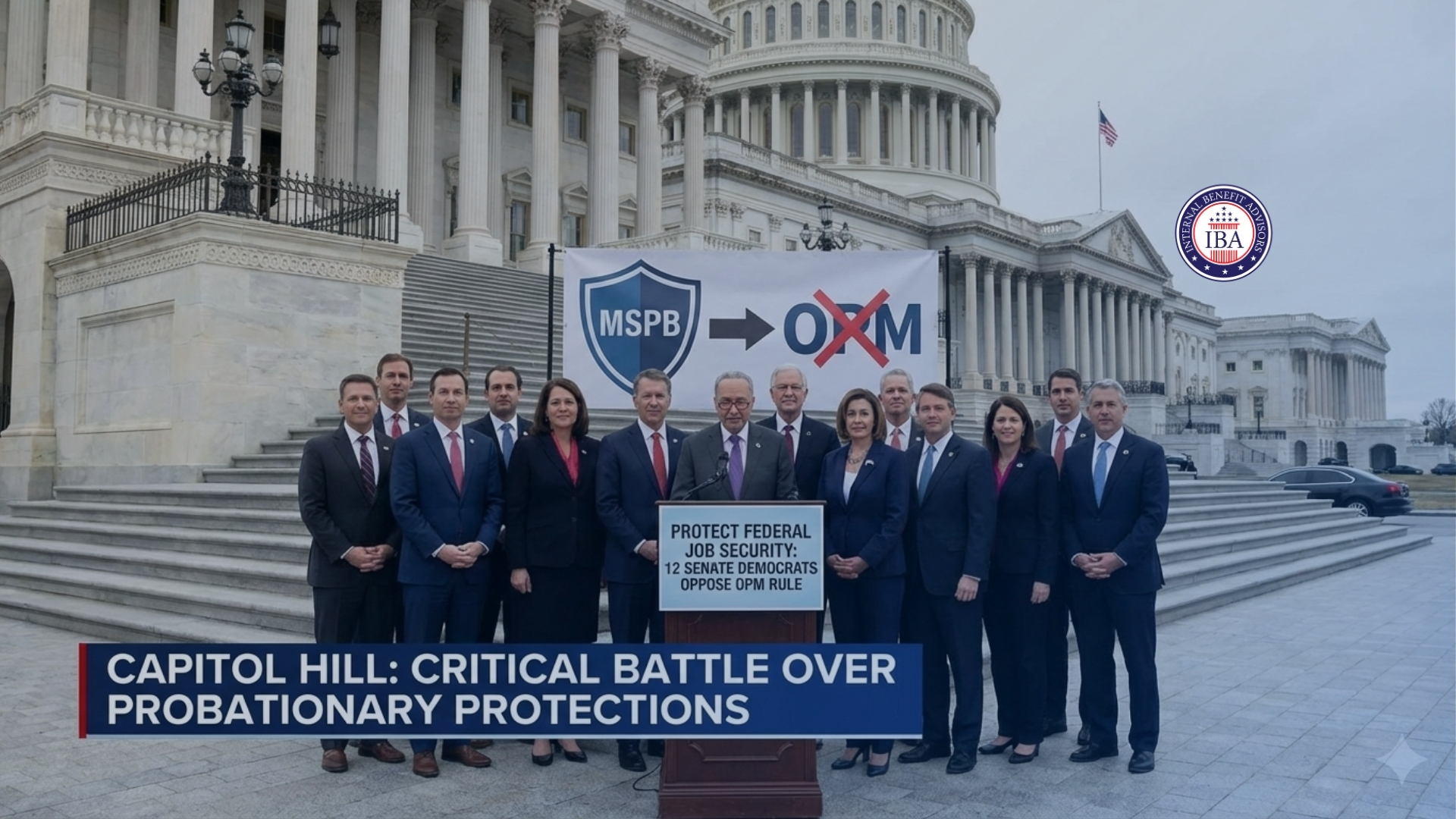

A critical battle over the future of federal job security is unfolding on Capitol Hill. As reported by FEDweek, a coalition of 12 Senate Democrats is formally opposing a proposed Office of Personnel Management (OPM) rule that would fundamentally weaken the already-thin protections for probationary employees.
The proposal seeks to strip the Merit Systems Protection Board (MSPB) of its jurisdiction over probationary appeals, transferring that authority to an internal OPM process. For the thousands of federal employees serving their first year (or two) of service, this change could turn a “limited right” into a “phantom right.”
🏛️ The Proposal: Replacing Judges with Bureaucrats
Currently, probationary employees have very limited avenues to appeal a termination. They can generally only appeal to the MSPB if they allege the firing was based on partisan political reasons or marital status. While narrow, this right provides a path to an independent third-party review.
The New Rule: The OPM proposal would remove the MSPB from the equation entirely for these specific claims. Instead:
- Internal Review: Appeals would be handled directly by OPM, not an independent board.
- Paper-Only: The default process would be a review of the paper record.
- No Hearings: Employees would lose the right to a hearing unless OPM “discretionarily” grants one.
The Senators argue this creates a “sham review process,” noting that without discovery or a hearing, proving that a firing was politically motivated becomes nearly impossible. As the letter states, this could allow an administration to “rely on external indicators—such as voter registration data—to justify removals” with zero accountability.
📉 Sound Data: The “Killing Field” of Federal Careers
Why does this procedural change matter? Because the probationary period is overwhelmingly where federal terminations happen.
1. The 70% Danger Zone: Historical data from the Government Accountability Office (GAO) indicates that approximately 70% of all performance-based removals in the federal government occur during the probationary period.
- The Implication: If you are going to be fired, it will statistically happen in year one. Removing the only independent check on this process leaves the majority of fired employees with no recourse.
2. The “Silent” Dismissals: While only roughly 1.6% of competitive service employees are officially removed during probation (according to MSPB data), this number is deceptively low. It does not account for:
- Coerced Resignations: Employees told to “resign or be fired” to avoid a permanent mark on their SF-50.
- Terminations for “Fit”: Agencies do not need to prove poor performance; they only need to state the employee is not a “good fit.”
⚠️ The “Prior Service” Loophole
Many employees believe they are “probationers” when they actually aren’t.
- The Rule: If you have prior federal service (even in a different agency or temporary status), that time might count toward completing your probationary period.
- The Case Law: Precedents like Van Wersch and McCormick established that some employees essentially “beat the clock” on probation due to previous credible service.
- The Risk: If OPM takes over appeals, the nuanced legal arguments that save these careers could be lost in a “paper-only” review.
🛡️ When the Safety Net Vanishes, Build Your Own
If the government is narrowing the exit door protections, you must widen your own safety net. You cannot rely on an MSPB judge to save your job in year one.
Internal Benefit Advisors helps you navigate the high-risk probationary minefield.
How We Help You Survive Year One (and Beyond):
- Tenure Group Audit: We review your SF-50 and prior service history to determine if you are truly a probationer. You may legally have full appeal rights without knowing it.
- “Resign vs. Fire” Analysis: If you are facing a probationary termination, we help you calculate the long-term impact of a resignation versus a removal on your future federal employability and benefits.
- FERS Refund Strategy: If you leave before 5 years, we help you decide whether to cash out your FERS contributions (a lump sum refund) or leave them in the system to preserve a future deferred annuity.
The Senators are fighting for your rights in Washington. You need to fight for your career in your agency.
Contact Internal Benefit Advisors today for a probationary status and benefits review.
References
- FEDweek. “Group of Senate Democrats Opposes Proposed Change in Probationers’ Appeal Rights.” February 3, 2026.
- Government Accountability Office (GAO). Federal Workforce: Improved Supervision and Better Use of Probationary Periods Are Needed to Address Substandard Employee Performance.
- U.S. Merit Systems Protection Board (MSPB). The Probationary Period: A Critical Assessment Opportunity.
Internal Benefit Advisors. Retrieved from https://internalbenefitadvisors.com