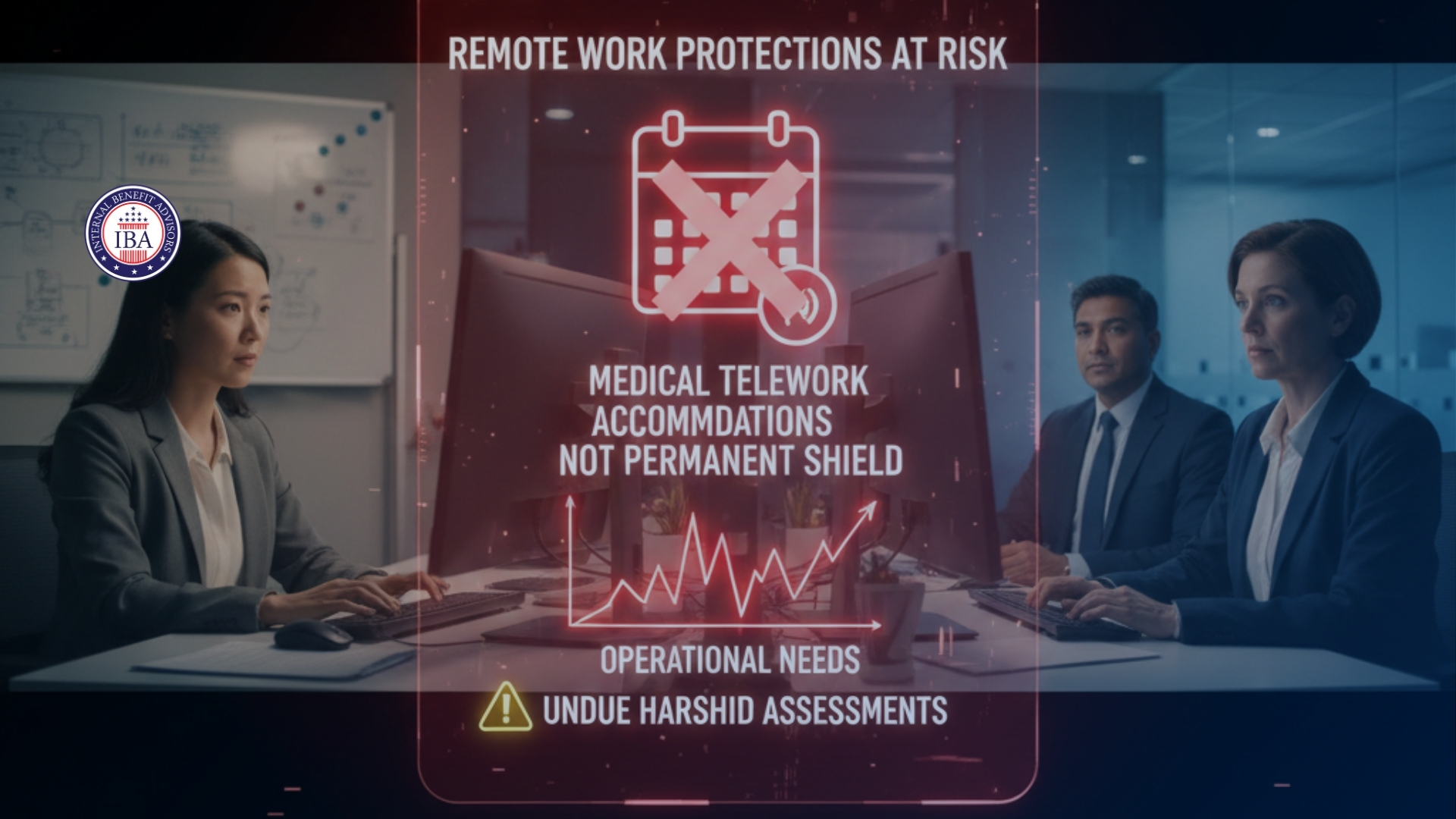

The “final frontier” of remote work protections is under review. As reported by FEDweek, the Office of Personnel Management (OPM) and the Equal Employment Opportunity Commission (EEOC) have issued joint guidance stating that federal agencies “may revisit and reassess” telework arrangements previously granted as reasonable accommodations.
For thousands of federal employees who believed their medical telework agreements were permanent shields against the return-to-office mandates, this news is a wake-up call. The guidance clarifies that a prior approval does not guarantee a future exemption, specifically if operational needs or “undue hardship” assessments change.
🏛️ The New Standard: “Reassess,” Not Revoke (Yet)
The guidance does not mandate a blanket revocation of disability-related telework, but it explicitly opens the door for agencies to scrutinize existing agreements.
Key Takeaways from the Guidance:
- Re-evaluation is Permitted: Agencies are authorized to review whether a medical condition still necessitates telework or if an alternative accommodation (e.g., a private office, HEPA filters, flexible scheduling) could be effective in the office.
- Medical Documentation: Agencies “may require” updated medical documentation to support the continued need for offsite work. A note from 2022 may no longer be sufficient in 2026.
- Undue Hardship Defense: The guidance reinforces that agencies can deny telework if it causes “undue hardship.” With the President’s mandate emphasizing in-person collaboration, agencies may now argue that permanent remote work creates a hardship on team operations that wasn’t present during the pandemic.
📉 Sound Data: The “Accommodation” Surge
The push to revisit these cases is driven by a massive shift in how federal employees are using the accommodation process.
- The “Remote” Reality: Before the recent return-to-office mandates, approximately 10% of the federal workforce fell under remote work exceptions. As general telework policies tightened, the volume of reasonable accommodation requests spiked as employees sought a protected status to remain home.
- CDC Precedent: We are already seeing this play out at the agency level. The Centers for Disease Control and Prevention (CDC) recently attempted to pause or remove remote work as a reasonable accommodation, sparking immediate union backlash and highlighting the volatility of these agreements.
- The “Interactive” Gap: Data suggests a growing bottleneck. As requests surge, the “interactive process”—the required dialogue between agency and employee—is becoming adversarial. Denial rates for telework as a primary accommodation are rising as agencies pivot to offering “in-office” alternatives instead.
⚠️ The “Effective Alternative” Trap
The most dangerous part of this guidance for employees is the concept of the “effective alternative.”
- The Law: The Rehabilitation Act requires an agency to provide an effective accommodation, not necessarily the preferred one.
- The Shift: If you request telework for anxiety or focus issues, your agency may now counter-offer with “noise-canceling headphones and a cubicle in a quiet corner.” If that alternative is deemed “effective” by OPM standards, they can legally deny your telework request and order you back to the office.
🛡️ Protect Your Status: Verify Your Accommodation
If your ability to work depends on your telework agreement, you cannot assume it is safe. You need to prepare for a “reassessment” notice before it arrives.
Internal Benefit Advisors helps you navigate the complex intersection of medical need and federal employment law.
How We Help You Defend Your Accommodation:
- Medical Documentation Review: We help ensure your medical evidence specifically addresses why in-office alternatives are insufficient, making it harder for the agency to propose a “quiet corner” as a substitute.
- FERS Disability Retirement Analysis: If the agency revokes your telework and you physically cannot return to the office, you may be eligible for FERS Disability Retirement. We help you determine if a “failure to accommodate” strengthens your application for immediate medical retirement benefits.
- Interactive Process Coaching: We guide you through the “reassessment” meetings, helping you articulate your needs without inadvertently agreeing to an ineffective in-office compromise.
The agency is reviewing your file. Make sure your file is ready for the review.
Contact Internal Benefit Advisors today for a reasonable accommodation and disability retirement assessment.
References
- FEDweek. “Agencies ‘May Revisit and Reassess’ Offsite Work Allowed as an Accommodation, Says OPM.” February 12, 2026.
- OPM & EEOC. Frequently Asked Questions (FAQs) on Telework Accommodations for Disabilities in the Federal Government. February 12, 2026.
- Internal Benefit Advisors. Retrieved from https://internalbenefitadvisors.com