
The Office of Personnel Management (OPM) has opened a third front in its effort to consolidate personnel power. Following proposals to remove MSPB oversight from reductions in force (RIFs) and probationary terminations, OPM has now issued a proposed rule to strip the Merit Systems Protection Board (MSPB) of its jurisdiction over suitability appeals.
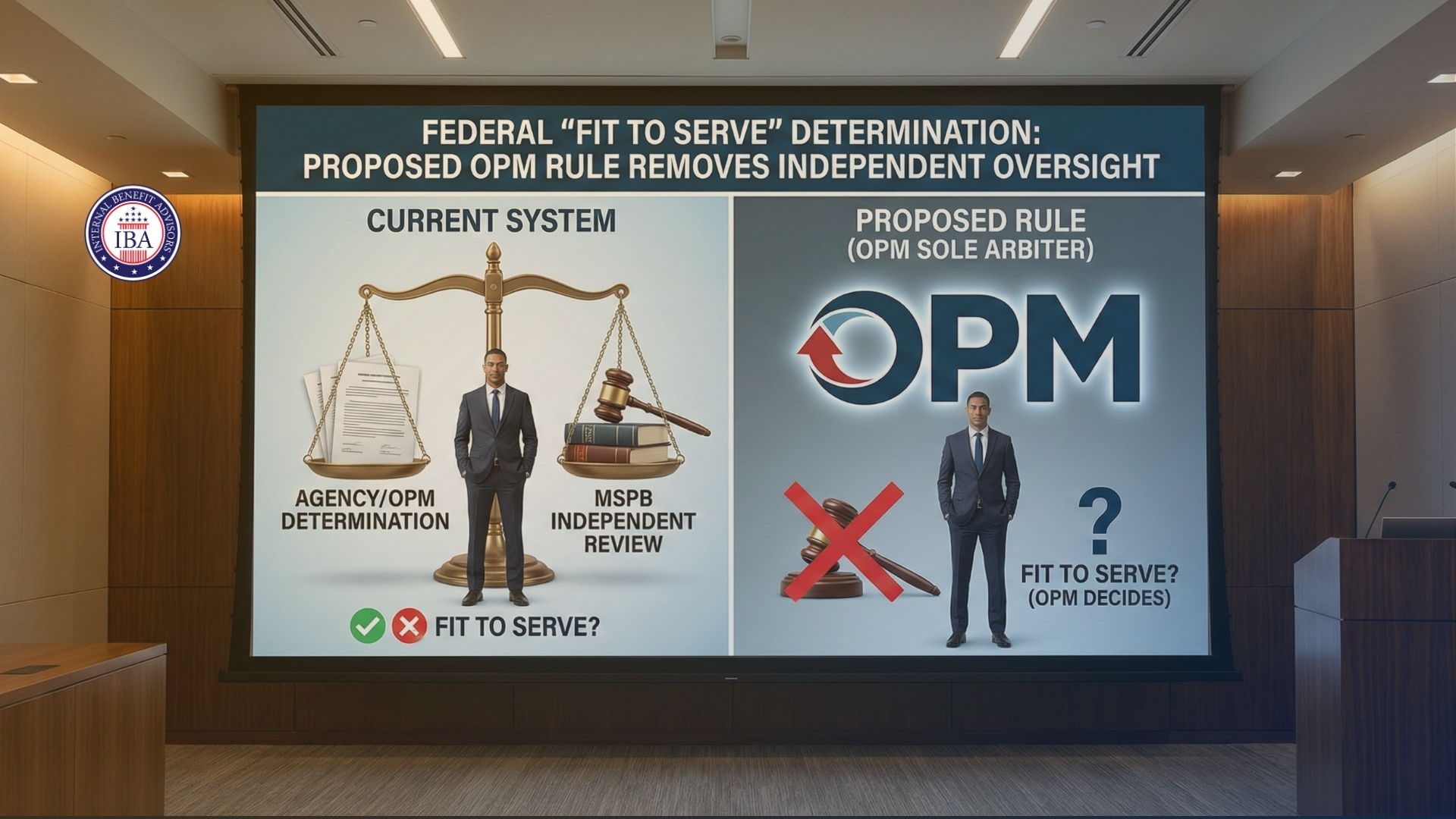
As reported by FEDweek, this proposal would fundamentally alter how the federal government determines who is “fit” to serve. Under the current system, if OPM or an agency deems you “unsuitable” for federal employment—due to issues like material false statements, criminal conduct, or integrity concerns—you have the right to appeal that disqualification to the independent MSPB.
Under the new rule, that independent check disappears. OPM would become the sole arbiter of its own decisions, creating a closed loop where the accuser is also the appellate judge.
🏛️ The Proposal: No Judge, Just Bureaucrats
“Suitability” is the gateway to the civil service. It determines not just if you can hold your current job, but if you can hold any federal job.
The Current System: If an agency finds you unsuitable (e.g., for lying on an OF-306 or SF-86), they can remove you. You can currently appeal this to the MSPB, where an administrative judge reviews the evidence, hears witnesses, and ensures the penalty fits the alleged offense.
The Proposed System:
- MSPB Removal: The proposed rule explicitly removes suitability actions from the list of appealable actions to the MSPB.
- Internal Review: Appeals would be directed to OPM itself. The review would be conducted “on the written record,” meaning no hearing, no cross-examination of witnesses, and no discovery process to find out why you were flagged.
- Finality: OPM’s decision would be final, with limited to no recourse for judicial review.
📉 Sound Data: The “Debarment” Death Sentence
Why is this dangerous? Because a suitability action is arguably worse than a standard firing. It comes with debarment.
- The 3-Year Ban: When an employee is removed for suitability, OPM or the agency can impose a government-wide debarment for up to 3 years. This means you are blacklisted from all federal employment, not just at your current agency.
- The “Resignation” Trap: Data shows that many employees resign when faced with a suitability inquiry to avoid the mark on their record. However, under 5 CFR Part 731, OPM can continue a suitability investigation even after you resign. If they find you unsuitable post-resignation, they can still impose the debarment, effectively blocking your return to service.
- The “Material” Threshold: Suitability actions often hinge on “material false statements.” Without an independent judge to interpret what is “material” (vs. a simple typo or memory lapse), OPM has broad discretion to label honest mistakes as integrity violations, triggering the 3-year ban.
⚠️ The “Clean Record” Risk
This proposal poses a specific threat to employees with long tenures who undergo reinvestigations (T3/T3R or T5/T5R).
- Reinvestigation Vulnerability: You may have served for 15 years, but a new background check could flag a discrepancy in your financial history or a past omission.
- The Consequence: If OPM takes jurisdiction, a 20-year career could be ended by an internal administrative decision regarding “character,” with no independent board to weigh your years of good service against the new derogatory information.
🛡️ Protect Your Exit Strategy
If the government removes the independent referee, the game becomes much riskier. You cannot rely on a fair hearing to save your career if your suitability is questioned.
Internal Benefit Advisors helps you navigate the financial fallout of a suitability action.
How We Help You Manage the Risk:
- Resignation vs. Removal Calculation: If you are facing a suitability inquiry, we analyze the impact of resigning immediately versus waiting for a decision. While we do not give legal advice, we help you understand how a “clean” resignation affects your ability to cash out your FERS contributions or access your TSP.
- Deferred Annuity Preservation: If you are debarred for 3 years, you may need to rely on a Deferred Retirement. We calculate the future value of your pension to ensure you don’t forfeit it out of panic during the investigation.
- Refund of Contributions: If the debarment effectively ends your federal career, we help you determine if taking a refund of FERS contributions (a lump sum of what you paid in) is a better financial move than waiting 20 years for a small deferred pension.
The gatekeepers are locking the doors. Make sure you have a key to your financial future.
Contact Internal Benefit Advisors today for a benefits analysis and separation strategy review.
References
- FEDweek. “Suitability: OPM Wants to Take Over Appeals, Cutting Out MSPB.” February 12, 2026.
- Federal Register. Suitability and Fitness for Government Employment (Proposed Rule). 5 CFR Part 731.
- U.S. Merit Systems Protection Board. judges’ Handbook: Suitability Appeals.
- Internal Benefit Advisors. Retrieved from https://internalbenefitadvisors.com