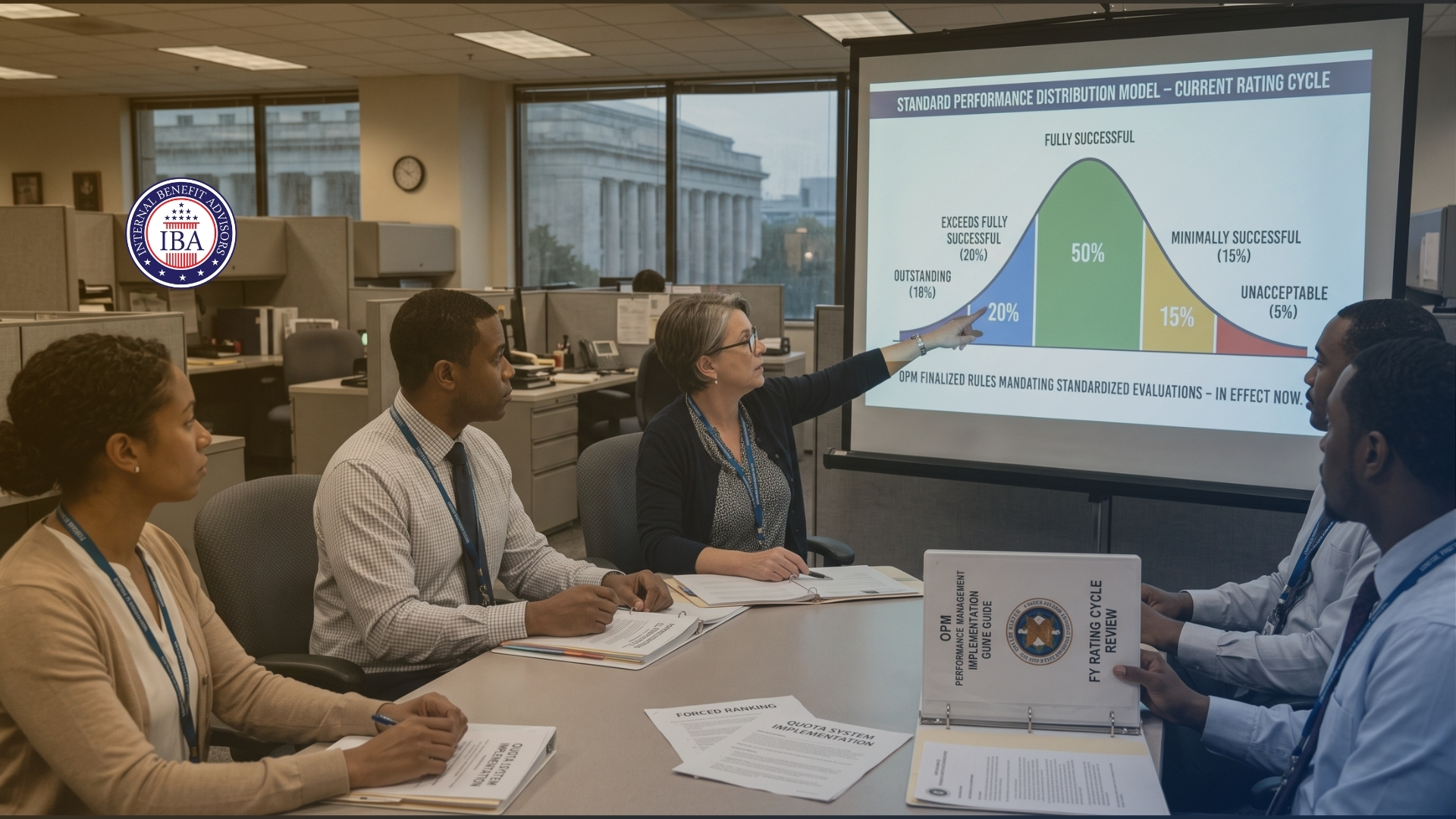
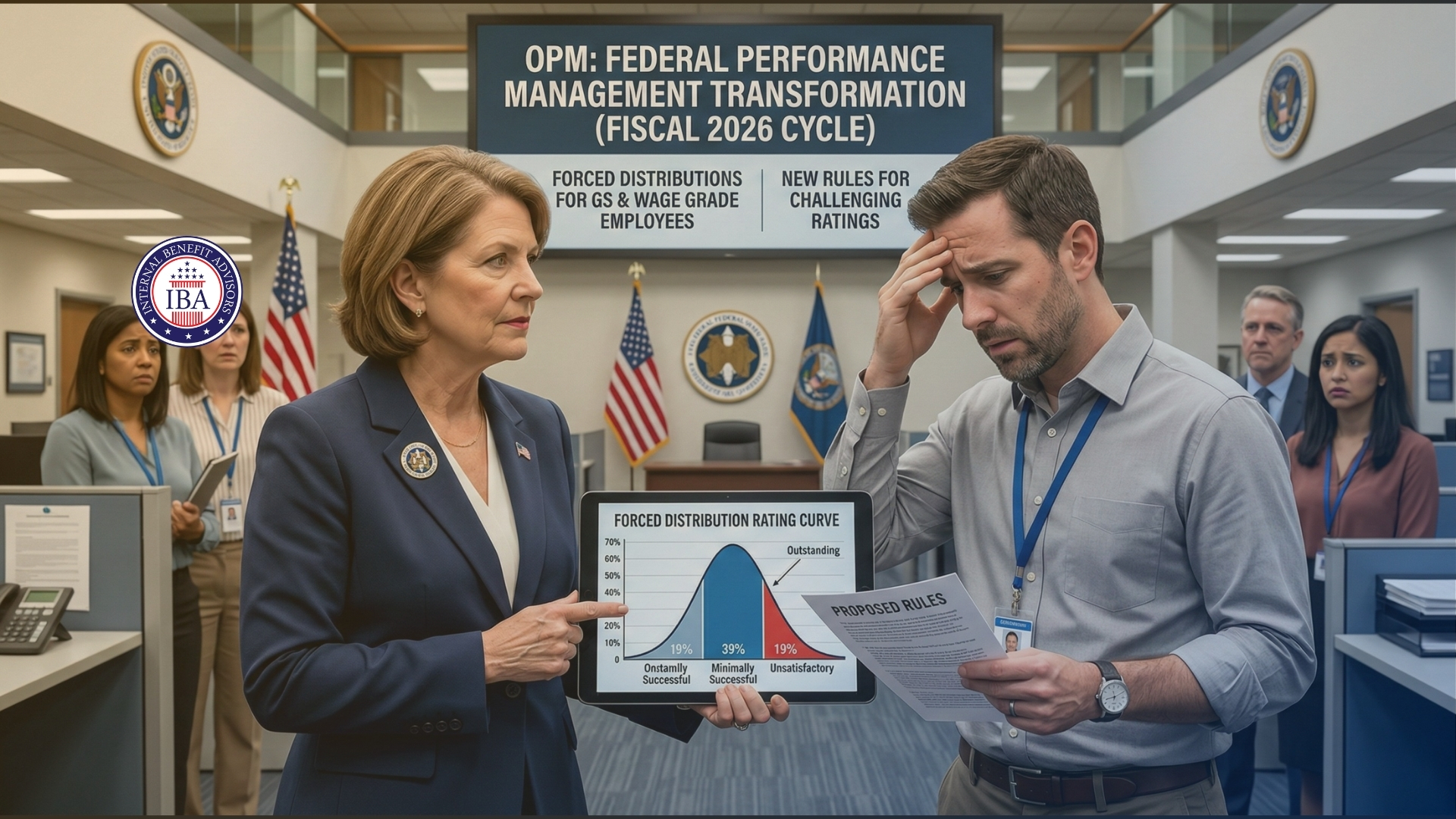

The landscape of federal performance management is undergoing its most drastic transformation in decades. As reported by FEDweek, the Office of Personnel Management (OPM) has issued proposed rules to implement “forced distributions” for all General Schedule (GS) and wage grade employees, beginning in the current fiscal 2026 evaluation cycle.
This directive not only forces agencies to grade employees on a strict curve, but it simultaneously rewrites the rules for challenging those ratings. For the average federal worker, the era of guaranteed high performance scores and union protection during appraisal disputes has officially ended.
🏛️ The “New Math” of Federal Performance
The new regulations go far beyond simply capping the number of top ratings. They fundamentally restructure how performance is categorized and contested.
Key Changes in the February 2026 Rules:
- Grievance Rights Eliminated: The rules explicitly eliminate an employee’s right to grieve a performance rating through union-negotiated processes, such as arbitration. If you disagree with a downgraded rating, your only recourse is an “informal reconsideration” within the agency that issued it.
- Level 2 Erased: OPM is proposing the complete elimination of Level 2 (“Minimally Successful”). The rationale is that any rating below “Fully Successful” signifies a failure to meet expectations. This effectively merges Level 2 into Level 1 (“Unacceptable”).
- Pass/Fail Ban: Two-level (pass/fail) evaluation systems are now prohibited for the vast majority of the competitive workforce.
📉 Sound Data: The Mathematical Downgrade
To understand the financial and career impact of this rule, you have to look at the massive gap between historical rating data and the new mathematical caps. OPM has explicitly stated that current ratings are “inflated” and fail to distinguish actual performance differences.
- The Current Reality: According to historical OPM data cited in the Federal Register, in recent years nearly 43% of federal employees received an “Outstanding” (Level 5) rating, and another 22% received an “Exceeds Fully Successful” (Level 4). In four-level systems, an astonishing 90% of employees were rated in the top two tiers.
- The New Cap: While the new rules for GS employees do not hardcode a specific percentage yet, OPM directives instruct agencies to mirror the model recently implemented for the Senior Executive Service (SES). That model strictly limits the number of employees who can be rated in the top two levels (4 and 5) to a maximum of 30%.
- The Implication: To achieve this forced distribution, agencies will mathematically be required to downgrade more than half of their currently high-performing workforce from a Level 4/5 down to a Level 3 (“Fully Successful”), regardless of their actual work output.
⚠️ The Hidden Danger: RIFs and Disciplinary Action
While agency leadership may claim there is “no shame” in a Level 3 rating, the regulations governing federal employment say otherwise. Your rating is a critical defensive tool.
1. The RIF Seniority Penalty In a Reduction in Force (RIF), your retention standing is calculated by adding “credit” years to your actual service time based on your last three ratings.
- A Level 5 rating typically adds 20 years of service credit.
- A Level 3 rating typically adds only 12 years of service credit. By mathematically forcing an employee down to a Level 3, the agency quietly strips them of 8 years of retention seniority, making them highly vulnerable to layoffs if the agency downsizes.
2. The “Level 1” Trap By eliminating Level 2, the margin for error disappears. If a manager determines you are struggling and drops your rating below a Level 3, you immediately fall into Level 1 (“Unacceptable”). A Level 1 rating commonly triggers immediate disciplinary action, including a Performance Improvement Plan (PIP) or outright removal.
🛡️ Defend Your Career and Your Wallet
With performance bonuses likely drying up for the ~70% of the workforce pushed into the middle tiers, and union arbitration rights vanishing, you must adapt your financial and career strategy immediately.
Internal Benefit Advisors helps you navigate this tighter, riskier performance landscape.
How We Help You Adapt to the New Standard:
- RIF Retention Audit: We calculate your “adjusted” retention standing based on a projected Level 3 rating. If the new forced distribution puts you in the danger zone for a layoff, we help you evaluate proactive exit strategies, such as Voluntary Early Retirement Authority (VERA).
- Financial Resilience Planning: If you have relied on an annual performance cash bonus to fund your retirement or pay down debt, we help you adjust your TSP contributions and household budget to ensure your goals remain on track without that extra income.
- Exit Strategy Analysis: If the elimination of union grievance rights and the threat of a sudden Level 1 rating make your current position untenable, we analyze your eligibility for an immediate or deferred annuity, ensuring you secure your benefits before an adverse action can be taken against you.
The bell curve is here, and the rules of the game have changed. Make sure your retirement plan survives the shift.
Contact Internal Benefit Advisors today for a performance impact analysis and benefits review.
References
- FEDweek. “OPM Moves to Implement Forced Ratings Distributions across Federal Workforce.” February 24, 2026.
- FEDweek. “Rules Would Change Ratings Policies in Ways Beyond Forced Distribution.” February 24, 2026.
- Federal Register. Performance Evaluation Policies (Proposed Rules). February 2026.
- Internal Benefit Advisors. Retrieved from https://internalbenefitadvisors.com