
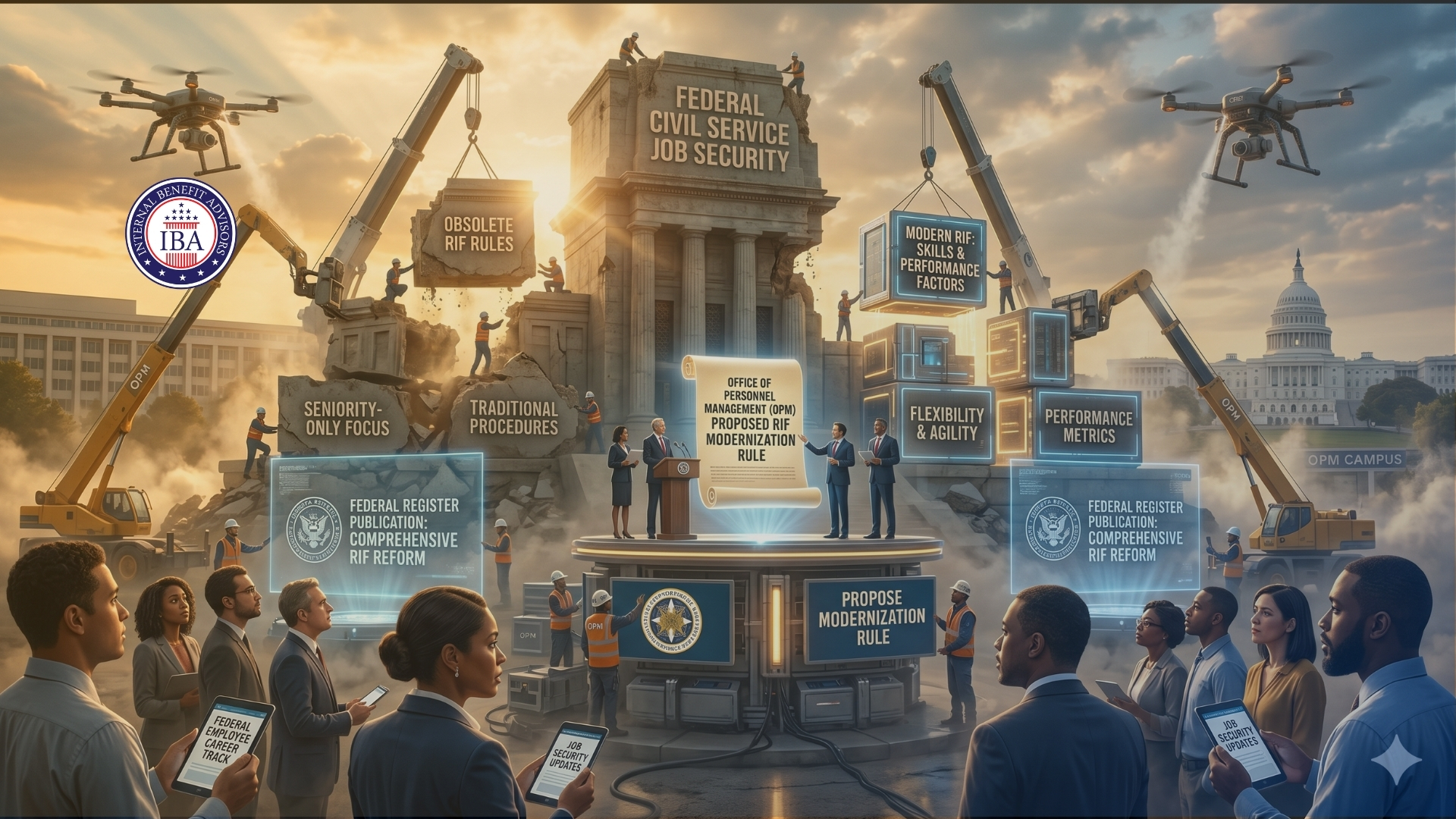

The fundamental rules governing job security within the federal civil service are facing an unprecedented structural overhaul. The Office of Personnel Management (OPM) recently published a comprehensive proposed rule in the Federal Register that fundamentally modernizes how Reductions in Force (RIFs) are executed across executive branch agencies.
For decades, long-term civil servants have relied on a predictable, objective framework where seniority and tenure served as the primary shields during agency downsizings. Under the newly proposed regulations, that paradigm is shifting entirely. Performance rankings are slated to become the ultimate determining factor in workforce retention, altering how federal professionals must approach their career longevity, performance evaluations, and retirement timelines.
The Proposed Transformation: Performance Over Seniority
Historically, an agency implementing a RIF constructed a retention register utilizing four statutory factors ordered by strict priority: tenure group (type of appointment), veterans’ preference, length of service, and performance ratings. Seniority frequently functioned as the ultimate tiebreaker, giving long-term civil servants substantial protection during structural contractions.
OPM’s proposed rule reorders these factors significantly to emphasize a merit-based system. Under the new formula, retention standing within a competitive level will turn primarily on a weighted sum of an employee’s three most recent performance appraisals. The points scale down sharply based on performance tiers:
- 7 points for an “Outstanding” (Level V) rating
- 0 points for a “Minimally Successful” or “Unacceptable” rating
Crucially, traditional tenure points would be reduced to zero, and the employee’s Service Computation Date (SCD) would function strictly as a secondary tie-breaker rather than a primary defense. Furthermore, OPM proposes to exclude career probationary employees, temporary workers, and Schedule C and G political appointees from RIF competition protections altogether, granting agencies broad authority to separate these categories without going through formal RIF procedures.
Shifting Appeals: The Loss of Independent Oversight
Compounding the modification of retention calculations is a parallel OPM regulatory proposal designed to streamline the RIF appeals process. Currently, a federal employee separated, demoted, or furloughed for more than 30 days via a RIF can appeal the action to the independent Merit Systems Protection Board (MSPB).
OPM’s proposal seeks to transfer total jurisdiction over RIF appeals away from the MSPB, placing it directly under OPM’s internal Office of Merit System Accountability and Compliance. The administration frames this as a vital efficiency measure to eliminate “cumbersome, lengthy, and expensive” proceedings. However, federal employee unions and congressional critics warn that removing third-party independent review diminishes vital due process protections, heavily tilting the administrative scales in favor of agency management.
The Numbers Driving the Civil Service Contraction
These proposed rules arrive on the heels of major shifts in the size of the federal workforce. Data released by OPM reveals that the federal civilian workforce contracted by 242,260 employees over a 12-month period due to a surge in resignations, forced separations, and accelerated retirements.
Federal Workforce Reductions & RIF Changes Summary
┌───────────────────────────────┬────────────────────────────────┐
│ HISTORIC RIF RULE │ PROPOSED RIF RULE │
├───────────────────────────────┼────────────────────────────────┤
│ Seniority/Tenure Protected │ Performance Appraisals First │
│ Independent MSPB Appeals │ Internal OPM Managed Appeals │
│ Broad Competitive Protections │ Probationary Workers Excluded │
└───────────────────────────────┴────────────────────────────────┘
Total Workforce Contraction (Recent 12 Months): 242,260 Personnel
With agencies facing sustained pressure to realign personnel with emerging technologies and restricted budgets, administrative toolkits are being reshaped to facilitate swifter workforce drawdowns. For a mid-to-late-career federal employee, an unexpected downgrade in a performance evaluation is no longer just a hurdle for an annual bonus—it could realistically position you at the top of a layoff list.
Proactive Measures: What Federal Employees Should Do Now
Faced with a shifting regulatory landscape, waiting for a formal RIF notice to land on your desk is a high-risk strategy. Federal personnel must pivot to a proactive defensive posture immediately by focusing on three core areas:
- Audit and Secure Your Personnel File: Review your Electronic Official Personnel Folder (eOPF) to ensure that every performance appraisal from the last four years is accurately uploaded and recorded. Request formal, written copies of your performance elements and track your progress to avoid surprise downgrades.
- Understand “Bumping” and “Retreating” Rights: Under RIF rules, an employee released from their competitive level may have the right to displace (“bump”) an employee in a lower subgroup, or “retreat” to a position they previously held. Knowing your qualifying qualifications and classification series is vital to understanding where you land if your current position is abolished.
- Assess Your Voluntary Retirement Eligibility: For those approaching the horizon of their civil service career, a localized RIF or reorganization can trigger early retirement windows, such as the Voluntary Early Retirement Authority (VERA) or Voluntary Separation Incentive Payments (VSIP).
Securing Your Future Amid Structural Transition
When the structural guardrails of the civil service are modified, individual financial security depends on clear education and external guidance. Navigating complex federal benefit structures—especially when your high-3 average salary, Federal Employees’ Group Life Insurance (FEGLI), and pension calculations are tied directly to your retention standing—requires specialized expertise.
This is where dedicated support becomes indispensable. Internal Benefit Advisors provides comprehensive financial education, life insurance structuring, tax guidance, and tailored retirement planning designed specifically for federal and state employees.
Whether you need to project your retirement readiness in the event of an unexpected agency downsizing, optimize your Thrift Savings Plan (TSP) allocations, or understand how a potential RIF-driven demotion impacts your high-3 annuity calculation, working with an experienced advisor ensures your financial plan remains insulated from shifting civil service rules.
In an era where performance ratings dictate career longevity and independent appeals routes are narrowing, taking control of your personal benefits strategy is the most definitive career move you can make.
References
- Office of Personnel Management (OPM). (2026). Reduction in Force: Proposed Rule. 5 CFR Part 351, Federal Register (91 FR 10904, Document Number 2026-04377). https://www.federalregister.gov/documents/2026/03/05/2026-04377/reduction-in-force
- Office of Personnel Management (OPM). (2026). Reduction in Force Appeals: Proposed Rule. 5 CFR Part 351, Federal Register (91 FR 5861, Document Number 2026-02576). https://www.federalregister.gov/documents/2026/02/10/2026-02576/reduction-in-force-appeals
- FedWeek. (2026). If OPM’s Proposed RIF Rules Become Final, What Federal Employees Should Do Now. https://www.fedweek.com/federal-managers-daily-report/if-opms-proposed-rif-rules-become-final-what-federal-employees-should-do-now/
- Government Executive. (2026). OPM Proposes New Layoff Rules Emphasizing Performance and Reducing Employee Protections. https://www.govexec.com/management/2026/03/opm-proposes-new-layoff-rules-emphasizing-performance-and-reducing-employee-protections/411892/
- Democracy Forward Foundation. (2026). Public Comment on OPM’s Proposed Rule: Reductions in Force. https://democracyforward.org/work/regulations/office-of-personnel-managements-proposed-rule-reductions-in-force/
- Internal Benefit Advisors LLC. Retirement Planning Support and Benefits Package Education for State and Federal Employees. https://internalbenefitadvisors.com