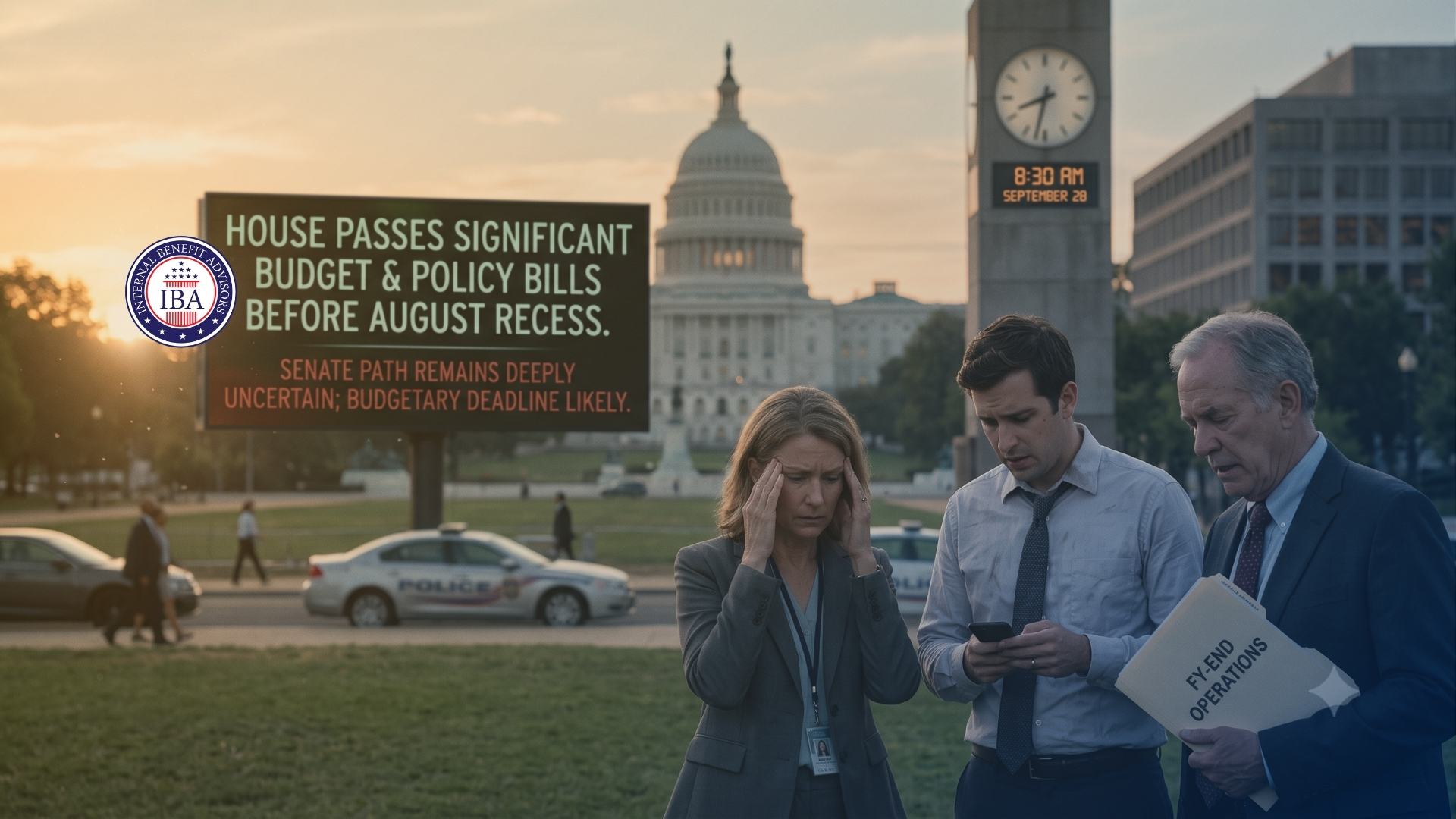

As the September 30th fiscal year-end rapidly approaches, the familiar rhythm of congressional gridlock has returned to Washington. According to recent reporting by FEDweek, the House of Representatives passed a trio of highly significant budget and policy bills just before breaking for their August recess. However, the path forward for these measures in the Senate remains deeply uncertain, leaving career civil servants caught in the crosshairs of looming budgetary deadlines.
When Congress leaves town with only a fraction of its appropriations work completed, the threat of a funding lapse or a disruptive Continuing Resolution (CR) skyrockets. For federal professionals, this recurring legislative brinkmanship requires shifting from a reactive posture to a highly proactive, independent financial defense strategy.
Sound Data: Deconstructing the Legislative Logjam
To understand the true risk to agency operations and personal financial stability, one must look at the specific details of the three bills recently passed by the House and the structural hurdles they face:
- The Funding Extension (Continuing Resolution): Acknowledging that regular appropriations bills will not be finished on time, the House passed a measure to extend agency funding largely at current levels through December 4th.
- The Hurdle: The Senate is not expected to take up this specific measure, preferring an undefined alternative approach. This guarantees that avoiding a shutdown will come down to a last-minute, high-stakes negotiation in September. Historically, Congress has relied on CRs in all but three of the last 47 fiscal years.
- The Defense Authorization Bill & Union Rights: The House passed its version of the annual must-pass defense authorization bill. Crucially for the workforce, this version includes language that would repeal the Pentagon’s recent controversial order disavowing union contracts and representation rights for most of its employees in bargaining units.
- The Hurdle: The Senate has set aside its own version of the defense bill, raising the prospect of heading straight to conference negotiations. The Senate version does not include the repeal of the union cancellation, meaning these vital collective bargaining rights will be heavily contested in back-room negotiations.
- The Budget Reconciliation Blueprint: The House passed a $95 billion budget reconciliation blueprint allocating funds for defense, intelligence, farm relief, and the controversial “SAVE Act.”
- The Hurdle: Reconciliation bills require only a simple majority in the Senate. However, Senate rules mandate that such bills be strictly budget-related. The inclusion of voting policy language makes the bill’s survival in the Senate highly precarious, reminiscent of past instances where the Senate parliamentarian stripped out House-passed language targeting federal employee retirement benefits.
- The Pay Raise Default: Notably absent from finalized legislation is a definitive position on the 2027 federal employee pay raise. The general government spending bill is expected to take no position, meaning the White House’s recommendation—which initially proposed zero across-the-board increase but may be updated in late August—will likely take effect by default.
The Danger of Passive Career Management
The passage of these three bills illustrates a difficult reality: the rules governing your pay, your union protections, and your agency’s funding are being actively negotiated in a highly partisan, unpredictable environment.
Relying on last-minute congressional deals to ensure a smooth, uninterrupted career trajectory is a dangerous financial posture. The record-setting shutdown of late 2018/early 2019 and recent department-specific lapses prove that leadership in both branches is willing to use agency funding as leverage. Federal workers must build an independent financial perimeter.
Fortify Your Finances with Internal Benefit Advisors
When your agency’s budget and your workplace rights are trapped in legislative limbo, your personal financial strategy must remain completely secure. At Internal Benefit Advisors, we specialize in bulletproofing the finances of federal professionals against institutional uncertainty:
- Furlough Liquidity and TSP Triage: With a shutdown threat looming for September 30th, we help you evaluate your cash flow and optimize your Thrift Savings Plan (TSP) to ensure you have the emergency liquidity necessary to bridge a potential gap in pay without incurring unnecessary early withdrawal penalties.
- Strategic Exit Planning (VERA/VSIP): If prolonged CRs or sudden budget cuts prompt your agency to offer Voluntary Early Retirement Authority (VERA) or buyout packages (VSIP) as part of a restructuring effort, we provide the exact mathematical projections you need to make an empowered decision regarding your lifetime FERS or CSRS annuity.
- Defensive TSP Optimization: The stock market often reacts negatively to the threat of a U.S. government shutdown or debt ceiling crisis. We offer expert counseling on your TSP allocations to shield your accumulated capital from politically driven market volatility.
- Complimentary Retirement Paperwork Processing: If congressional gridlock prompts you to accelerate your retirement timeline, do not risk agonizing delays in your interim pay by navigating the notoriously backlogged OPM system alone. Our experts audit and complete your retirement paperwork for FREE, ensuring a flawless application and an immediate, steady income stream.
Take Command of Your Financial Readiness
The House has passed its trio of bills, but the Senate’s response—and the final outcome for your agency’s budget—remains a dangerous unknown. You cannot control the legislative calendar or the passage of appropriations, but you have absolute authority over your personal financial readiness.
Take command of your career transition today. Contact the experts at Internal Benefit Advisors for a Free Benefit Assessment and ensure your hard-earned wealth remains secure, regardless of the budget battles on Capitol Hill.
References
- FEDweek. House Passes Trio Budget, Policy Bills, but Path Ahead Uncertain for Each. FEDweek.com
- Internal Benefit Advisors. Information you need, Support you can trust. InternalBenefitAdvisors.com
- National Low Income Housing Coalition (NLIHC). House Republicans Pass Blueprint for $95 Billion Reconciliation Package.
- Congressional Research Service (CRS). Continuing Resolutions: Overview of Components and Practices.