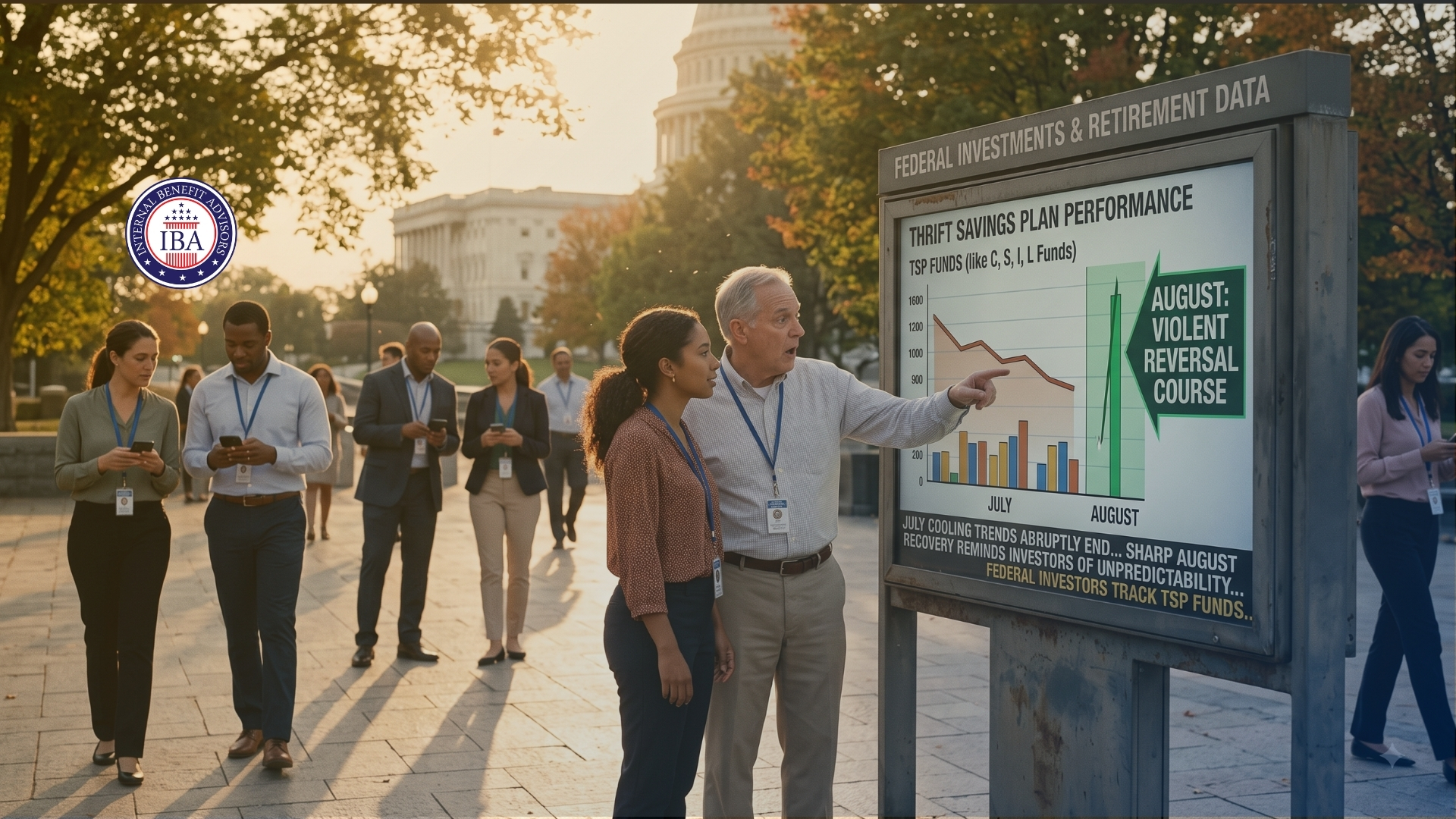

For federal investors, the late summer months have delivered a stark reminder that the financial markets are anything but predictable. After a robust first half of the year, the Thrift Savings Plan (TSP) experienced a sudden, across-the-board cooling in July, only to violently reverse course in the opening days of August.
According to recent reporting by FEDweek, July was a down month for four of the five individual TSP funds. However, the first week of August saw massive index surges, temporarily erasing the July retreat. For the career civil servant, this rapid “whipsaw” market action is a critical warning: relying on a passive, “set-and-forget” TSP strategy during periods of high geopolitical and economic volatility leaves your life savings dangerously exposed.
Sound Data: Deconstructing the Summer Swings
To understand the true risk to your retirement timeline, one must look beyond the headline bounces and analyze the specific data driving this volatility, as well as the underlying structural risks in the TSP:
- The July Retreat: The FEDweek data shows that the S Fund (Small Cap) took the hardest hit in July, falling 4.12 percent. The I Fund (International) dropped 1.01 percent, and the C Fund (S&P 500) essentially stalled out, slipping 0.07 percent. Only the ultra-conservative G Fund managed a positive return of 0.39 percent.
- The August Rebound: August opened with a dramatic surge. The Dow climbed 1,000 points and the tech-heavy Nasdaq rose over 2.5 percent, driven largely by shifting geopolitical news regarding the Strait of Hormuz.
- The Danger of Tech Concentration: FEDweek rightly points to “eye-watering AI-related spending” as a driver of volatility. This is a critical piece of additional data for C Fund investors. The top 10 companies in the S&P 500 (which the C Fund tracks) currently make up roughly 35 percent of the entire index’s weight. When sentiment around artificial intelligence or semiconductor debt shifts, the C Fund experiences highly magnified price swings.
- The G Fund Inflation Trap: While the G Fund was the only safe haven in July, retreating to it out of fear is mathematically dangerous over the long term. A 0.39 percent monthly gain translates to an annualized return of roughly 4.6 percent. When factoring in taxes and a persistent baseline inflation rate hovering around 3 percent, capital parked entirely in the G Fund is barely maintaining its purchasing power.
- Sequence of Returns Risk (SORR): This volatility is most dangerous for feds within five years of retirement. If the market drops sharply right as you begin making withdrawals, the mathematical damage is catastrophic. You are forced to sell shares at depressed prices, meaning your portfolio may never recover its previous high-water mark, even if the market eventually bounces back.
The Danger of Passive Wealth Management
The wild swings between July and August prove that the market is currently trading on headlines—geopolitical tensions, tech sector debt issuance, and shifting global trade agreements.
If your retirement is quickly approaching, you cannot afford to ride this rollercoaster blindfolded. Reacting emotionally—such as dumping all your C and S funds into the G fund after a 4 percent drop in July, only to miss the 2.5 percent surge in early August—destroys compounding wealth. Federal professionals must transition from passive accumulation to active, defensive wealth management.
Fortify Your TSP with Internal Benefit Advisors
Navigating a volatile market requires a fiduciary-level strategy that removes emotion from the equation. At Internal Benefit Advisors, we specialize in transforming standard TSP portfolios into highly optimized, resilient wealth engines designed to survive market turbulence:
- Defensive TSP Optimization: We evaluate your current TSP allocations to identify areas of dangerous overexposure (such as top-heavy C Fund tech risk). We help you rebalance your portfolio to lock in the double-digit gains you achieved earlier in the year while maintaining a shielded posture that outpaces inflation.
- Sequence of Returns Risk Mitigation: If you are nearing retirement, a market correction can ruin your timeline. We design distribution strategies that protect your principal from short-term crashes, ensuring you never have to sell off your core equities at a loss during a down month.
- Precise Retirement Income Projections: Uncertainty breeds panic. We run exact mathematical projections combining your High-3 average, your projected FERS or CSRS annuity, and your optimized TSP withdrawals to show you exactly what your net monthly income will look like in any market condition.
- Complimentary Retirement Paperwork Processing: When you are ready to transition, do not let market stress be compounded by bureaucratic chaos. Our experts audit and complete your notoriously complex OPM retirement paperwork for FREE, guaranteeing a pristine application that prevents costly processing delays in your interim pay.
Take Command of Your Financial Trajectory
The turbulent shift from July’s losses to August’s gains is a clear signal that the financial markets are entering a highly reactive phase. You cannot control the geopolitical headlines or the daily movements of the S&P 500, but you have absolute authority over your personal asset allocation.
Take command of your wealth transition today. Contact the experts at Internal Benefit Advisors for a Free Benefit Assessment and ensure your hard-earned TSP balance remains strategically protected, no matter which way the market swings.
References
- FEDweek. July a Down Month for All but the G Fund; August Bounces Back. FEDweek.com
- Internal Benefit Advisors. Information you need, Support you can trust. InternalBenefitAdvisors.com
- Federal Retirement Thrift Investment Board (FRTIB). Thrift Savings Plan (TSP) Monthly Returns and Fund Performance Data.