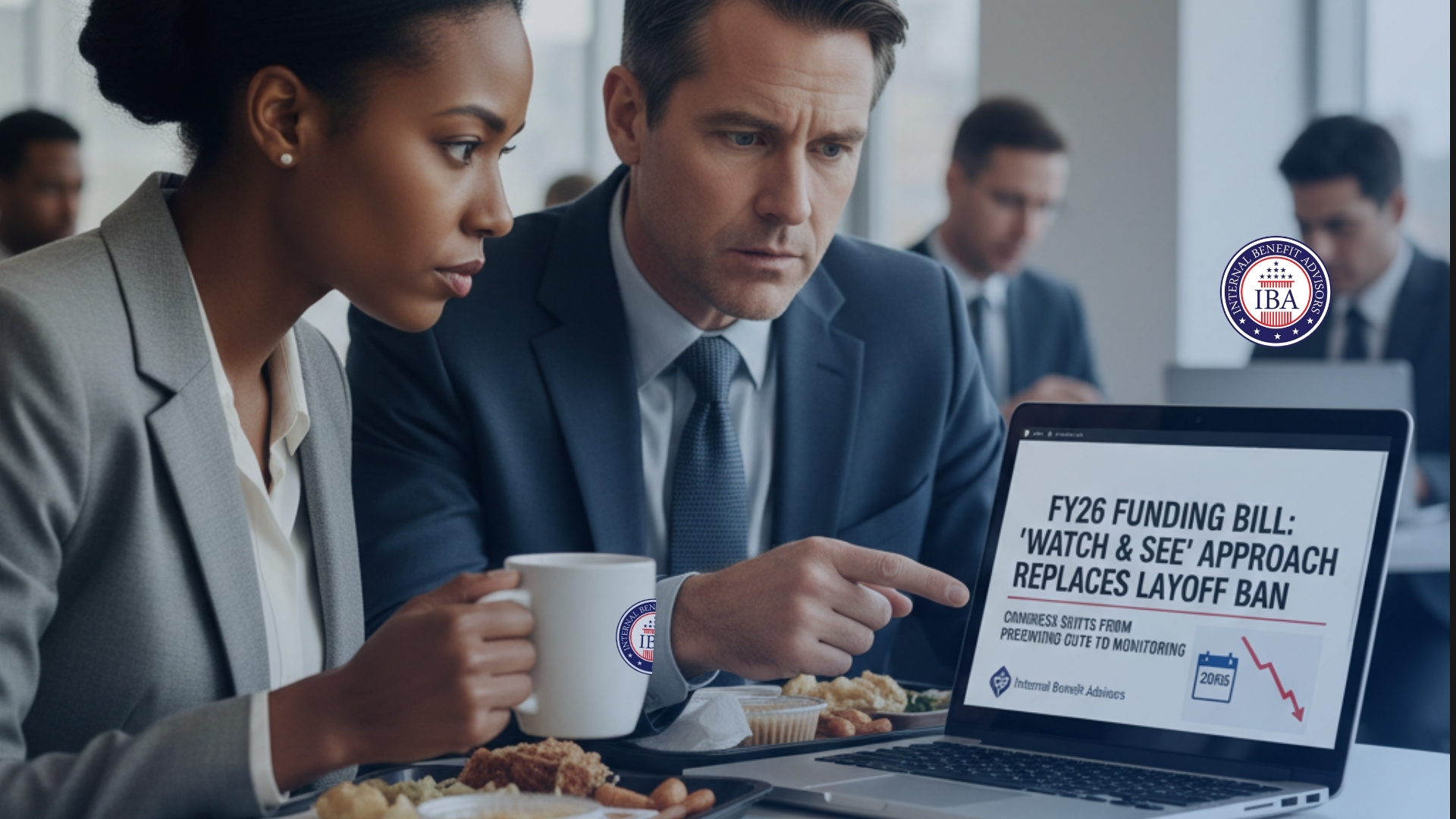

The latest federal funding bill for fiscal year 2026 has emerged with a distinct mix of “business as usual” and alarming new signals for the federal workforce. As reported by FEDweek, the legislation retains long-standing prohibitions while introducing new requirements that shift Congress from preventing workforce cuts to merely monitoring them.
For federal employees, this bill is a signal that the protective guardrails of 2025 are being dismantled, replaced by a “watch and see” approach that could accelerate downsizing in the coming months.
🏛️ The “Old”: Familiar Restrictions Remain
The bill keeps several legislative “riders” that have become standard operating procedure for the federal government. While these are not new, their continued presence shapes the daily reality of agency operations.
- Training Ban: The bill continues the prohibition on using appropriated funds for training that is not directly related to an employee’s official duties. This restricts agencies from offering broad professional development unless it has a clear, immediate mission connection.
- A-76 Privatization Ban: In a win for job security, the bill retains the moratorium on using OMB Circular A-76 to convert federal jobs to private contractor positions. This long-running ban prevents a wholesale outsourcing of civil service functions.
- Identity Protection: The bill requires OPM to assess extending the identity theft and credit monitoring protections originally provided after the 2015 OPM data breaches, ensuring continued safety for affected employees.
🆕 The “New”: Reporting Cuts Instead of Stopping Them
The most critical shift in this bill is what it doesn’t do. Unlike the temporary continuing resolution that explicitly banned Reductions in Force (RIFs), this new measure allows that moratorium to expire on January 30, 2026.
In its place, the bill introduces a “workforce census” requirement.
- The Mandate: OPM must report to Congress every 60 days with detailed data on workforce reductions, broken down by agency, occupation, and duty station.
- The Implication: Congress is no longer hitting the “pause” button on downsizing; they are simply asking for a scorecard. This effectively greenlights agencies to resume stalled RIF actions as long as they report the numbers.
- Dropped Provisions: Notably, the final bill dropped two controversial House provisions: a ban on gender-affirming care in FEHB plans and a ban on ESG (Environmental, Social, and Governance) investments in the TSP mutual fund window.
📊 Sound Data: The Financial Reality of 2026
The policy changes in this bill land in an economic environment that is already squeezing federal employees from both sides—pay and job security.
1. The “Real Wage” Cut: While the bill solidifies the 2026 pay structure, the numbers reveal a loss in purchasing power.
- The Raise: Most civilian employees received a 1.0% across-the-board increase.
- The Inflation: The latest Bureau of Labor Statistics (BLS) data shows the Consumer Price Index (CPI-U) rose by 2.7% over the last 12 months.
- The Result: Federal employees have effectively taken a 1.7% pay cut in real terms this year, making financial efficiency more critical than ever.
2. The Downsizing Trend: The new “reporting” requirement is tracking a massive exit of talent.
- 277,000 Jobs Lost: According to BLS data from December 2025, the federal workforce has shrunk by approximately 277,000 positions since its peak in January 2025.
- Agency Targets: The reductions are not evenly spread. Data shows the Department of Agriculture (USDA) shedding over 5,000 jobs and the Social Security Administration (SSA) losing nearly 2,500 staff, signaling where the RIF risks are highest.
3. TSP Performance vs. Policy: The decision to drop the “ESG ban” for the TSP comes on the heels of a stellar year for international investments.
- I Fund Dominance: The TSP I Fund (International) posted a massive 32.45% return in 2025, significantly outperforming the C Fund (17.85%) and S Fund (11.38%).
- The Lesson: Restricting investment choices based on political criteria could have forced investors out of the year’s top-performing asset class. Diversification remains the ultimate safety net.
🛡️ Strategy Over “Wait and See”
With the RIF moratorium ending and paychecks trailing inflation, relying on “business as usual” is a risky strategy. Internal Benefit Advisors helps you build a personal defense plan that works regardless of what Congress decides.
How We Connect to Your Needs:
- RIF Preparedness: With the ban lifting Jan 30, we help you audit your Service Computation Date (SCD) and retention standing now, so you aren’t scrambling if a notice arrives in February.
- Budgeting for the “Real” Cut: We help you adjust your cash flow and TSP contributions to absorb the 1.7% loss in purchasing power without derailing your retirement goals.
- Investment Optimization: We help you analyze whether your TSP portfolio is properly diversified to capture growth like the I Fund’s recent rally, ensuring you aren’t leaving money on the table due to fear or inertia.
The bill has passed. Now you must pass the test of preparing for its impact.
Contact Internal Benefit Advisors today for a comprehensive review of your benefits and career security.
References
- FEDweek. “Funding Bill Has Some Things Old, Some Things New.” January 13, 2026.
- FEDweek. “Spending Bill Seeks Data on Federal Workforce Cuts but Wouldn’t Prevent More.” January 13, 2026.
- Bureau of Labor Statistics (BLS). Consumer Price Index Summary – December 2025.
- Bureau of Labor Statistics (BLS). The Employment Situation – December 2025.
- Internal Benefit Advisors. Retrieved from https://internalbenefitadvisors.com
Outstanding 2025 TSP Performance! Which Fund Had the Highest Return?
This video reviews the final 2025 performance data for all TSP funds, confirming the I Fund’s top position and discussing the importance of diversification mentioned in the article.