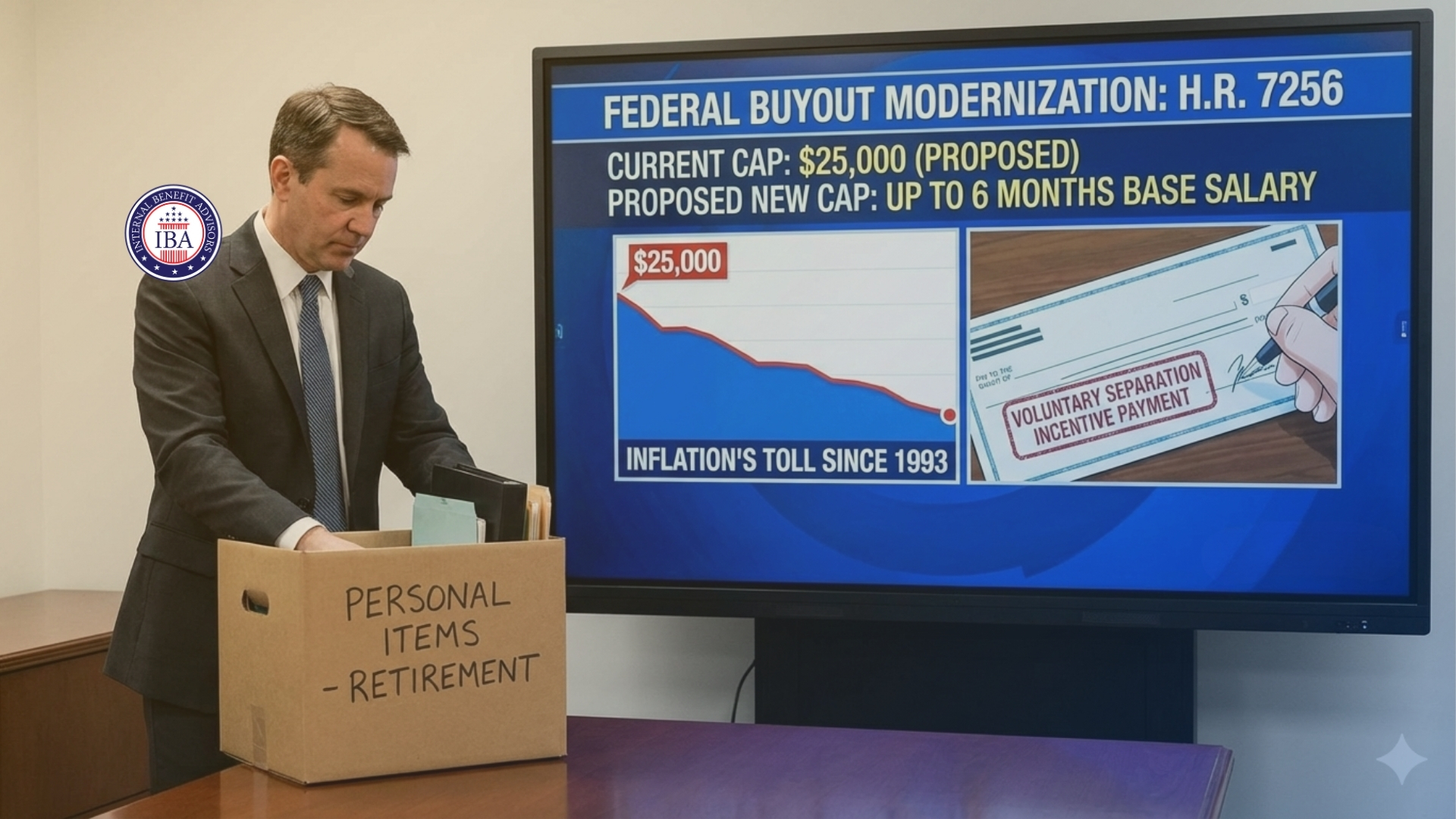

The financial incentive for federal employees to voluntarily leave service is on the verge of its most significant update in over 30 years. As reported by FEDweek, the House Oversight and Government Reform Committee is considering H.R. 7256, a bill that would replace the outdated $25,000 buyout cap with a dynamic limit of up to six months of base salary.
For decades, the Voluntary Separation Incentive Payment (VSIP)—commonly known as the buyout—has been stuck at a flat $25,000. This figure, established during the Clinton administration, has lost more than half its value to inflation. The new proposal acknowledges that a 1990s-era incentive is no longer sufficient to reshape the workforce in 2026.
📉 Sound Data: The “Shrinking” $25,000 vs. The New Proposal
To understand why this bill matters, you have to look at the purchasing power lost over the last three decades. The $25,000 cap is effectively a “pay cut” compared to what was offered to your predecessors.
- The Inflation Gap: According to the Bureau of Labor Statistics (BLS) CPI inflation calculator, $25,000 in 1993 has the same buying power as approximately $55,600 today. By keeping the cap at $25,000, the government has allowed the real value of the incentive to erode by over 55%.
- The New Math (Six Months’ Pay): Under H.R. 7256, the cap shifts to a salary-based percentage.
- Scenario: A GS-13, Step 5 employee earning roughly $130,000 annually.
- Current Buyout: Capped at $25,000.
- Proposed Buyout: Potentially eligible for $65,000 (50% of annual salary).
- The Net Difference: This represents a 160% increase in the gross payout. Even after mandatory taxes, the difference is life-changing: a $25k buyout often nets only ~$16,000, whereas a $65k buyout could net ~$41,000, providing a genuine financial bridge for early retirement.
🏛️ Why Now? The RIF Alternative
The timing of this legislation is strategic. Following the expiration of the government-wide RIF (Reduction in Force) moratorium on January 30, agencies are legally free to resume downsizing efforts.
However, RIFs are expensive, demoralizing, and legally messy. Agencies prefer voluntary separations. The problem is that in 2026, $25,000 is rarely enough to convince a mid-career employee to walk away from a stable federal salary. By raising the cap to six months’ pay and indexing it to inflation, Congress aims to give agencies a “soft landing” tool that employees will actually accept, preventing the need for involuntary layoffs.
- The DoD Precedent: The Department of Defense (now Department of War) briefly utilized a $40,000 buyout cap, which expired in 2021. This bill seeks to codify a higher standard government-wide, recognizing that the “one size fits all” $25k model is broken.
🛡️ Is the “Golden Handshake” Worth It?
A $60,000+ check is tempting, but it comes with a catch: VSIP offers almost always prohibit you from returning to federal service for 5 years. Before you raise your hand, you need to ensure the math works for your specific retirement timeline.
Internal Benefit Advisors helps you evaluate the offer beyond the headline number.
How We Analyze Your Buyout Strategy:
- “Bridge the Gap” Analysis: We calculate if the net buyout amount is enough to cover your living expenses until you can access your TSP or Social Security without early withdrawal penalties.
- Pension Loss Calculation: If you leave 3–5 years early to take a buyout, you permanently reduce your FERS annuity (1% per year of service missed). We compare the one-time cash infusion against the lifetime loss of pension income to see if you actually come out ahead.
- Tax Impact Strategy: A lump-sum buyout is taxed as ordinary income and can spike your tax bracket. We help you structure your TSP withdrawals and other income sources for the year to minimize the IRS bite.
The buyout might be getting bigger. Make sure your financial plan is big enough to handle the transition.
Contact Internal Benefit Advisors today for a buyout vs. retention analysis.
References
- FEDweek. “Boost in Value of Buyout Incentives under Consideration in House.” February 2, 2026.
- Bureau of Labor Statistics (BLS). CPI Inflation Calculator (1993–2026).
- U.S. House of Representatives. H.R. 7256 – Voluntary Separation Incentive Payment Adjustment Act.
- Internal Benefit Advisors. Retrieved from https://internalbenefitadvisors.com