
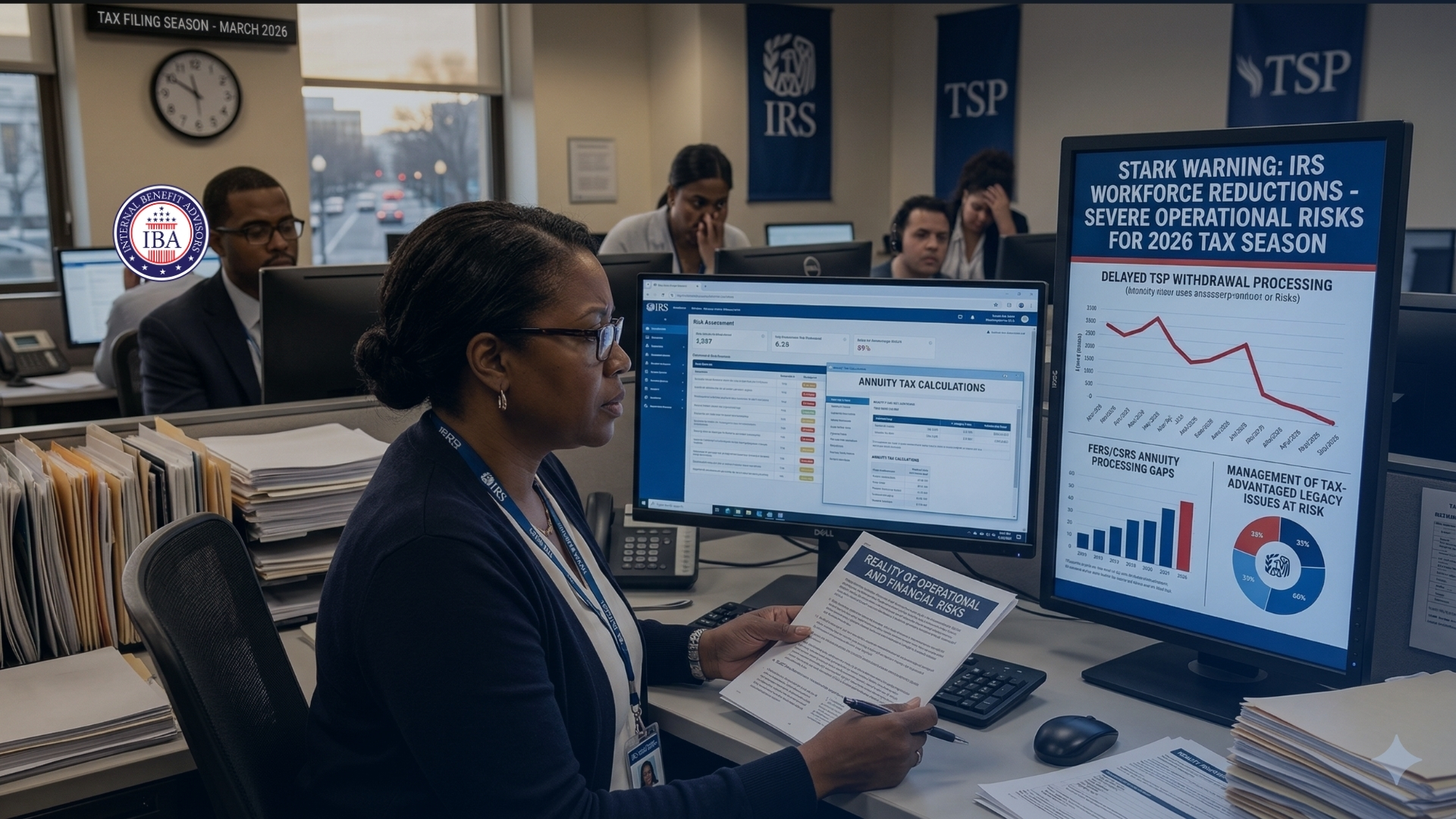

The federal landscape is experiencing unprecedented structural shifts, and the Internal Revenue Service (IRS) is currently at the epicenter. A newly released Government Accountability Office (GAO) report, recently highlighted by FEDweek, issues a stark warning: massive workforce reductions at the IRS have put critical operations for the 2026 tax filing season at severe risk.
For federal employees and retirees, the IRS is not just a collection agency; it is the entity that processes your Thrift Savings Plan (TSP) withdrawals, taxes your FERS or CSRS annuity, and manages your tax-advantaged legacy. Understanding the reality of these operational risks is the first step in protecting your financial health.
The Reality of the IRS Workforce Reductions
While the 2025 tax season functioned relatively smoothly, the GAO notes that this was an administrative illusion. The IRS deliberately required filing season staff who accepted deferred resignations or early retirements to stay until after the April deadline. Now, the true impact of those departures is being felt.
Sound Data on the 2026 Crisis:
- A 27% Workforce Drop: According to the National Taxpayer Advocate, the IRS workforce plummeted from roughly 102,000 employees to approximately 74,000 in a matter of months.
- Customer Service Decimation: The number of Customer Service Representatives (CSRs) has been reduced by 22%. The GAO found that return processing and customer service functions have entered the 2026 season significantly understaffed and undertrained.
- The “OBBBA” Complication: At the exact moment the agency lost a quarter of its staff, it was tasked with implementing the extensive and complex tax law changes mandated by the new One Big Beautiful Bill Act (OBBBA).
- Soaring Processing Times: The loss of highly tenured employees has already contributed to a jump in the average time it takes the IRS to process paper returns and resolve taxpayer correspondence backlogs.
What This Means for Your Financial Future
When the IRS is understaffed and overwhelmed by new tax codes, the burden of accuracy shifts entirely to the taxpayer.
Relying on the IRS to quickly fix a processing error, clarify a tax-code question over the phone, or rapidly issue a delayed refund is no longer a viable strategy. If you make a mistake on your TSP withdrawal taxation, or if your retirement lump-sum payout is calculated incorrectly, you could be facing a correspondence battle that takes the IRS over 21 months to resolve—the current average wait time for certain victim assistance cases.
Bridging the Gap with Internal Benefit Advisors
In an environment where federal support systems are stretched to the breaking point, proactive, independent financial management is your strongest defense. You need a buffer between your hard-earned benefits and institutional backlogs.
At Internal Benefit Advisors, our dedicated team of professional planners, CPAs, and attorneys specializes in the unique intersections of federal benefits and tax law. We provide the structural support you need to navigate this turbulence:
- Proactive Tax Planning: We help you decode the new OBBBA tax laws before you file. By ensuring your tax strategy is airtight, we minimize your risk of triggering an IRS manual review or correspondence audit.
- TSP Withdrawal Strategies: The TSP is prone to costly, irreversible tax mistakes. We guide you on how to structure your distributions—including navigating Roth in-plan conversions—to prevent hidden tax nightmares.
- Retirement Paperwork Assistance: OPM and the IRS are both experiencing profound staffing shifts. We help you fill out your federal retirement paperwork for FREE, ensuring your FERS or CSRS package is flawless so your annuity payments aren’t delayed by administrative errors.
- Comprehensive Benefit Assessments: We review your entire portfolio, from FEGLI coverage to Social Security timing, ensuring your financial house is in order regardless of what happens in Washington.
Secure Your Financial Perimeter
The GAO has made it clear that the IRS is struggling to manage its basic operational mandate in 2026. Do not let agency bottlenecks derail your retirement timeline or your tax standing.
Contact Internal Benefit Advisors today for a Free Benefit Assessment and ensure your financial future is guided by trusted expertise, not left to chance in an agency backlog.
References
- FEDweek. (2026, March 17). IRS Job Cuts Put Critical Operations at Risk, GAO Says. * Internal Benefit Advisors. Information you need, Support you can trust. Services & Tax Planning
- U.S. Government Accountability Office (GAO). (2026, March 16). 2025 Tax Filing: Management of Agency Reforms and Workforce Planning Needed to Address Severe Risks to Future IRS Operations. [GAO-26-108116]
National Taxpayer Advocate. (2026, January 28). 2025 Annual Report to Congress.