
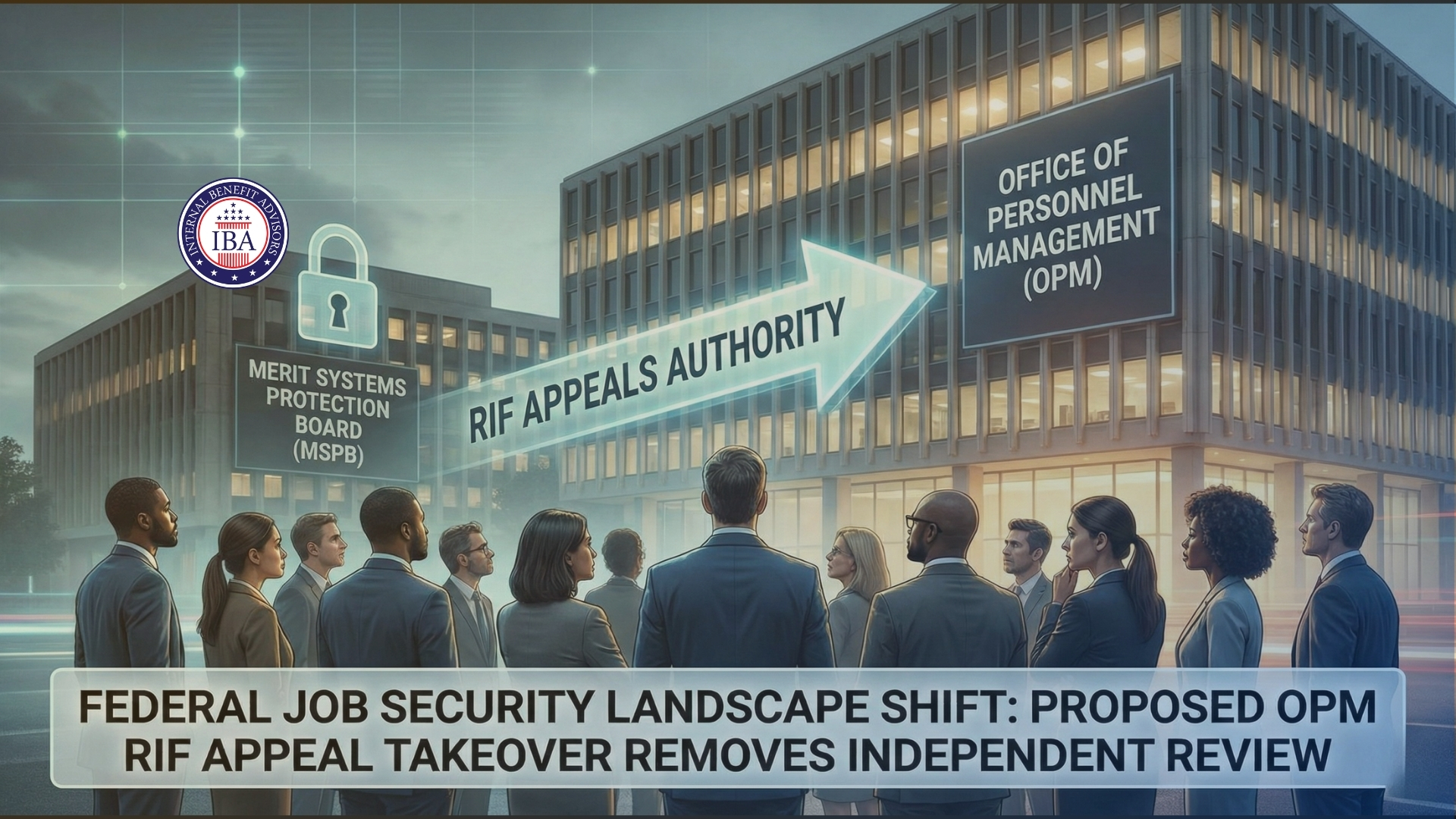

The Merit Systems Protection Board (MSPB) may soon lose its authority to hear appeals on reductions in force (RIFs), a shift that would fundamentally alter the landscape of federal job security. As reported by FEDweek, the Office of Personnel Management (OPM) has issued a proposed rule to transfer jurisdiction over RIF appeals directly to itself, stripping employees of an independent third-party review during layoffs.
This proposal, published in the Federal Register, would make OPM the “sole and exclusive” forum for challenging a RIF. For federal employees, this means the agency that writes the RIF regulations would also be the judge of whether those regulations were followed—a closed loop that critics argue removes essential checks and balances.
🏛️ The Proposal: A “Written Record” Review
Currently, employees separated or demoted by a RIF can appeal to the MSPB, an independent quasi-judicial agency. This process often involves discovery, witnesses, and a hearing before an administrative judge.
The New OPM Model: Under the proposed rule, this independent path disappears.
- No MSPB: Appeals would be filed directly with OPM.
- Paper-Only Default: The new process favors a review of the “written record.” Hearings would no longer be a right but would be granted only at OPM’s discretion if they deem it “necessary and efficient.”
- No Judicial Review: The proposal includes language attempting to foreclose judicial review of OPM’s final decisions, potentially blocking employees from taking their case to federal court if they lose.
OPM argues this change will “streamline” the process and reduce the burden on agencies. However, for an employee facing job loss, “streamlining” often looks like a reduction in due process.
📉 Sound Data: The “Independent” Gap
Why does the venue matter? Because the MSPB and OPM have vastly different mandates. Moving appeals to OPM fundamentally changes the odds.
- The “3%” Reality: Even under the current independent MSPB system, winning an appeal is difficult. Historical data shows that employees win relief in only about 3% of adjudicated cases. However, this statistic masks the value of the process: the threat of an MSPB hearing often forces agencies to settle.
- The Settlement Factor: MSPB data indicates that nearly 50% of appeals are settled or dismissed without prejudice before a final ruling. By removing the independent hearing mechanism, the leverage that forces agencies to settle—avoiding a public, messy hearing—evaporates.
- The “Sole and Exclusive” Clause: The proposed rule explicitly states that OPM’s process would supersede any negotiated grievance procedures. This affects the 1.2 million+ employees in bargaining units who might otherwise use arbitration to challenge a RIF.
⚠️ The Burden of Proof Shift
Perhaps the most technical but dangerous change is the burden of proof.
- Current Standard: In many personnel actions, the agency must prove it acted correctly.
- Proposed Standard: The new rule shifts the burden to the employee. You would have to prove by a “preponderance of the evidence” that the RIF was conducted contrary to regulation and that you would have kept your job if it had been done right. Proving this negative—without the discovery powers of an MSPB judge to demand agency documents—is a significantly higher hurdle.
🛡️ When You Can’t Appeal, You Must Plan
If the government is removing your ability to fight a layoff legally, you must ensure you can survive it financially. You cannot rely on a “written record” review to save your paycheck.
Internal Benefit Advisors helps you build a strategy that functions independently of OPM’s changing rules.
How We Help You Navigate RIF Uncertainty:
- Severance vs. Immediate Retirement: If a RIF hits, agencies often offer Voluntary Early Retirement Authority (VERA) or Voluntary Separation Incentive Payments (VSIP). We run the numbers to see if taking the “early out” (with a potentially reduced pension) is safer than fighting the RIF in the new OPM system.
- Retention Standing Audit: We review your SF-50 data (Tenure Group, Veterans’ Preference, Service Computation Date) now to ensure you are ranked correctly. If the RIF comes, your best defense is being high on the retention register, not appealing after you are cut.
- FERS “Exit” Analysis: If you are separated, we help you understand your options for a deferred annuity versus a refund of contributions, ensuring you don’t accidentally forfeit lifetime health benefits by making the wrong choice during a chaotic exit.
The rules of engagement are changing. Make sure your financial defense is ready.
Contact Internal Benefit Advisors today for a RIF preparedness and retirement benefits review.
References
- FEDweek. “RIFs Would be Appealed to OPM Rather than MSPB Under Proposed Rule.” February 10, 2026.
- Federal Register. Reduction in Force Appeals (Proposed Rule). 5 CFR Part 351.
- Merit Systems Protection Board. Annual Reports and Case Processing Statistics.
- Internal Benefit Advisors. Retrieved from https://internalbenefitadvisors.com
… 2.10 OPM Wants to Move RIF Appeals from MSPB into OPM—Cutting Independent Review …
This video provides a detailed breakdown of the proposed rule change, explaining how shifting RIF appeals to OPM removes independent oversight and what that specifically means for federal employee due process rights.
2.10 OPM Wants to Move RIF Appeals from MSPB into OPM—Cutting Independent Review