

The foundational protections that have insulated the federal civil service from political interference for decades are facing an unprecedented legal stress test. Following a sweeping decision by the Merit Systems Protection Board (MSPB) that severely limits employee appeal rights, labor advocates and attorneys are now urging a federal appeals court to reverse the ruling.
For career civil servants, this development underscores a critical modern reality: relying solely on institutional legal protections is no longer a guaranteed safety net. As administrative avenues for dispute resolution narrow, proactive financial and retirement planning is becoming the ultimate defense.
The Ruling: Article II vs. Civil Service Protections
The controversy centers on a landmark MSPB decision stemming from the 2025 firings of two immigration judges. An administrative law judge initially overturned their removals, noting that the agency failed to follow standard disciplinary procedures under the Civil Service Reform Act (CSRA). However, the Justice Department and the Office of Personnel Management (OPM) appealed the decision to the full MSPB.
In a stark departure from historical precedent, the MSPB ruled that the executive branch has the constitutional authority under Article II to fire these employees at-will. The board concluded that because the judges possessed significant adjudicative and policymaking authorities, they qualified as “inferior officers.” Consequently, the MSPB declared it lacked the constitutional jurisdiction to review the firings, stripping the employees of standard civil service recourse.
Attorneys for the fired judges have urgently appealed the decision to the U.S. Court of Appeals for the Federal Circuit. They warn that allowing agencies to bypass the MSPB by simply classifying an employee’s role as an “inferior officer” opens a massive loophole, threatening to regress the federal government into a patronage system.
Sound Data: A Coordinated Shift in Due Process
The MSPB ruling is not an isolated legal anomaly; it is part of a broader, systemic effort in 2026 to restructure the federal workforce and centralize removal authority. Relying on an appeals process is becoming increasingly difficult due to a combination of administrative backlogs and concurrent policy shifts:
- The Overwhelming Backlog: According to the MSPB’s Fiscal Year 2026 Congressional Budget Justification, the board is drowning in a historic caseload. As of early 2025, the MSPB had received over 11,166 appeals—twice its typical annual workload—severely delaying justice for employees fighting unjust terminations.
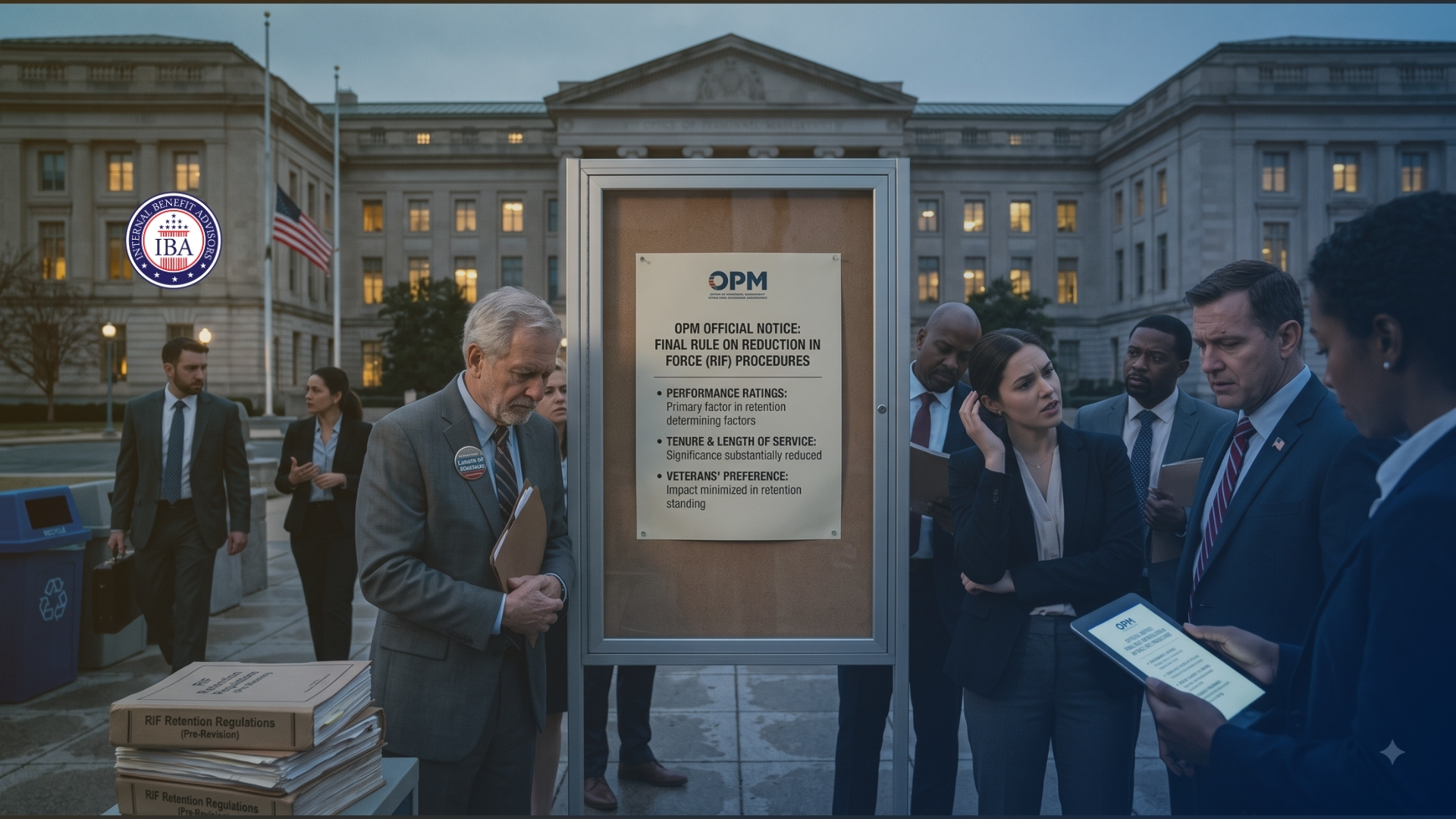
- OPM’s Internal Takeover: In February 2026, OPM published multiple proposed rules in the Federal Register seeking to completely strip the MSPB of jurisdiction over Reductions in Force (RIFs) and suitability-based disciplinary actions. Under these rules, OPM would internally adjudicate job losses based primarily on “written records,” eliminating an employee’s right to discovery and a formal hearing before an independent administrative judge.
- The Conflict of Interest: Nonpartisan groups, including the Partnership for Public Service, have strongly opposed these rules. They highlight the inherent conflict of interest in having OPM—the same agency that writes and administers the personnel and RIF policies—serve as the sole adjudicator of disputes regarding those exact policies.
Shielding Your Future with Internal Benefit Advisors
When your legal right to challenge a sudden termination is eroded by jurisdiction disputes and administrative rule changes, your personal financial readiness becomes your most critical asset. You cannot afford to wait for a years-long appellate court battle to determine if your pension and benefits are secure.
At Internal Benefit Advisors, we specialize in providing the fiduciary-level stability that federal employees need during periods of intense institutional volatility. We help you build a financial perimeter that protects your legacy, regardless of how your agency classifies your position:
- Severance and Early Retirement Strategies: If your position is targeted for a RIF or your agency attempts to bypass standard protections, we help you calculate the exact math of accepting a Voluntary Early Retirement Authority (VERA) offer versus waiting out the administrative storm.
- TSP Optimization: Career uncertainty requires a defensive financial posture. We provide expert counseling on Thrift Savings Plan (TSP) allocations, ensuring your capital is protected from market swings and accessible if your employment is abruptly disrupted.
- Complimentary Retirement Paperwork Assistance: If the shifting legal landscape prompts you to accelerate your retirement timeline, do not navigate the backlogged OPM system alone. We audit and process your FERS or CSRS paperwork for FREE, ensuring a flawless application that prevents costly delays in your annuity payments.
- Comprehensive Benefit Synchronization: Losing your federal status abruptly can jeopardize your life insurance and healthcare. We guide you through the intricate rules of bridging your Federal Employees Health Benefits (FEHB) and life insurance (FEGLI) coverage into retirement.
Take Control of Your Own Career Legacy
The recent MSPB ruling and OPM’s concurrent regulatory proposals serve as a clear warning: the definition of a “protected” federal employee is rapidly changing. While the federal courts will ultimately decide the legality of these shifts, your financial security is entirely within your control.
Don’t leave your hard-earned benefits at the mercy of an agency jurisdiction dispute. Contact the experts at Internal Benefit Advisors today to ensure your retirement timeline is dictated by your goals, not your agency’s restructuring agenda.
References
- FEDweek. Court Urged to Reverse MSPB Decision Limiting Employee Appeal Rights. FEDweek.com
- Internal Benefit Advisors. Information you need, Support you can trust. InternalBenefitAdvisors.com
- Government Executive. (2026, March). MSPB relinquishes jurisdiction over some federal worker appeals.
- U.S. Merit Systems Protection Board (MSPB). Congressional Budget Justification FY 2026.
- Federal Register. (2026, February 10). Office of Personnel Management Proposed Rule: Reduction in Force Appeals (RIN 3206-AO99).