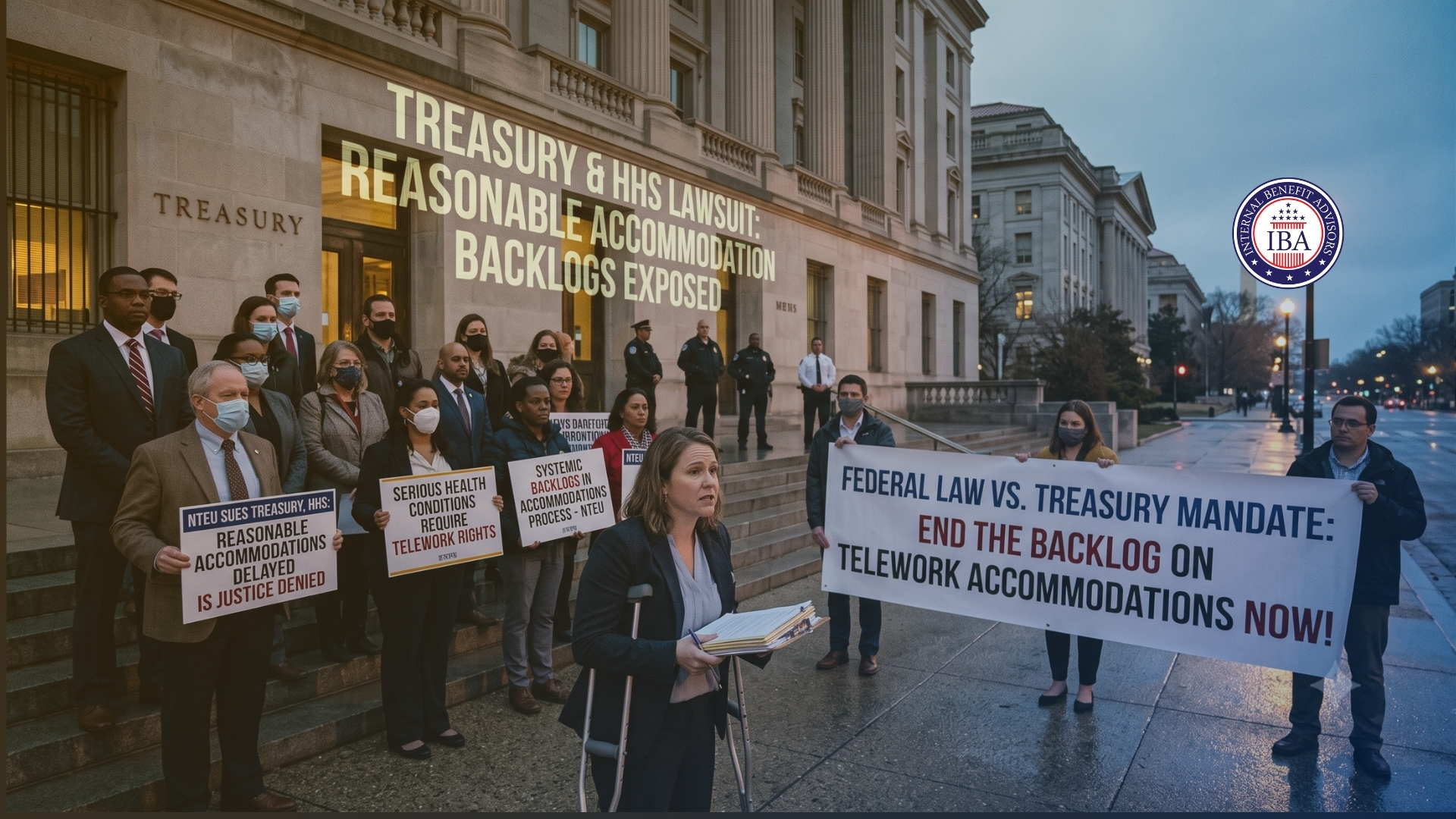

The federal government’s aggressive push for a return to in-person work has collided directly with the statutory rights of civil servants managing serious health conditions. In a major legal escalation, the National Treasury Employees Union (NTEU) has filed a lawsuit against the Department of the Treasury and the Department of Health and Human Services (HHS), citing massive, systemic backlogs in the processing of reasonable accommodation requests for telework.
According to recent reporting by FEDweek, employees with documented medical needs are being left in administrative limbo for months. As agencies drag their feet on processing these vital requests, career professionals are being forced into an impossible choice: return to the office and risk their physical health, or exhaust their hard-earned leave balances to stay home.
For federal employees caught in the crosshairs of strict office mandates and backlogged human resources departments, understanding the legal landscape and securing an independent financial safety net is absolutely critical.
Sound Data: The Mechanics of the Accommodation Backlog
To understand the gravity of the NTEU’s lawsuit, one must look at the legal framework governing federal workplaces and the sheer scale of the administrative failure currently occurring at these major departments:
- The Rehabilitation Act of 1973: Under federal law, agencies are legally mandated to provide reasonable accommodations to qualified employees with disabilities, provided it does not cause an “undue hardship” on agency operations. Since the COVID-19 pandemic, the Equal Employment Opportunity Commission (EEOC) has repeatedly affirmed that telework is a highly effective and legally sound accommodation.
- Violated Timelines: Standard federal guidelines—and internal agency policies—typically require reasonable accommodation requests to be processed and decided upon within 15 to 45 days. The NTEU lawsuit alleges that Treasury and HHS are routinely ignoring these deadlines, leaving employees waiting for months without a formal decision.
- The Financial Drain of LWOP: The backlog is not merely a bureaucratic annoyance; it has severe financial consequences. While waiting for a decision, many immunocompromised or severely disabled employees are forced to burn through their accrued sick and annual leave. Once those banks are depleted, they are pushed into Leave Without Pay (LWOP) status, immediately halting their income and disrupting their federal benefits.
- The Broader RTO Friction: Legal experts note that this backlog is a direct byproduct of recent, sweeping Return-to-Office (RTO) mandates. By issuing blanket orders to reduce telework, agencies triggered a massive surge in medical accommodation requests that their HR departments were entirely unequipped—or unwilling—to process efficiently.
The Danger of Institutional Limbo
When an agency fails to process a lawful medical accommodation request in a timely manner, it effectively weaponizes the bureaucracy against its own workforce. For a career civil servant, sitting in LWOP status while waiting for a bureaucratic stamp of approval is a highly destructive financial posture.
Extended periods of unpaid leave do not just drain your current bank account; they can permanently pause your Thrift Savings Plan (TSP) contributions and negatively impact your creditable service time, which ultimately reduces the value of your lifetime federal pension. You cannot afford to let an agency’s administrative backlog dismantle your retirement strategy.
Secure Your Independence with Internal Benefit Advisors
When your physical health and your paycheck are threatened by a stalled HR process, relying on union lawsuits or agency mercy is not enough. You must build an independent financial perimeter that allows you to weather the storm or exit the bureaucracy on your own terms.
At Internal Benefit Advisors, we specialize in providing the fiduciary-level financial guidance federal professionals require when facing severe workplace instability or medical hardships:
- FERS Disability Retirement Projections: If your agency refuses to accommodate your medical condition and you are unable to perform your duties, standard retirement may not be your only option. We provide exact mathematical projections on how a FERS Disability Retirement would impact your income, allowing you to transition out of the workforce with financial security.
- Leave Without Pay (LWOP) Financial Triage: If agency delays force you onto unpaid leave, we help you evaluate your cash flow and optimize your Thrift Savings Plan (TSP) to ensure you have the emergency liquidity needed to survive the backlog without incurring unnecessary tax penalties.
- Strategic Exit Planning: If the hostile administrative environment prompts you to consider an early exit, we calculate precisely how an accelerated retirement will impact your High-3 average salary and your lifetime annuity check before you make a permanent decision.
- Comprehensive Benefit Synchronization: We evaluate your entire federal portfolio to ensure your vital safety nets, particularly your Federal Employees Health Benefits (FEHB), remain securely intact and transition with you seamlessly, even if you are forced off the active payroll.
Take Command of Your Financial Trajectory
The NTEU lawsuit against Treasury and HHS highlights a stark reality: when executive mandates clash with employee well-being, the bureaucratic machinery frequently breaks down. You cannot control your agency’s HR processing times, but you have absolute authority over your personal financial readiness.
Take command of your career transition today. Contact the experts at Internal Benefit Advisors for a Free Benefit Assessment and ensure your hard-earned wealth and health benefits remain completely secure, no matter how long the agency takes to answer.
References
- FEDweek. NTEU Sues Treasury, HHS Over Backlog of Reasonable Accommodation Telework Requests.
- Internal Benefit Advisors. Information you need, Support you can trust. InternalBenefitAdvisors.com
- U.S. Equal Employment Opportunity Commission (EEOC). Enforcement Guidance on Reasonable Accommodation and Undue Hardship under the ADA.
- National Treasury Employees Union (NTEU). (2026, July). NTEU Takes Legal Action Against Agencies Ignoring Telework Accommodation Requests.