
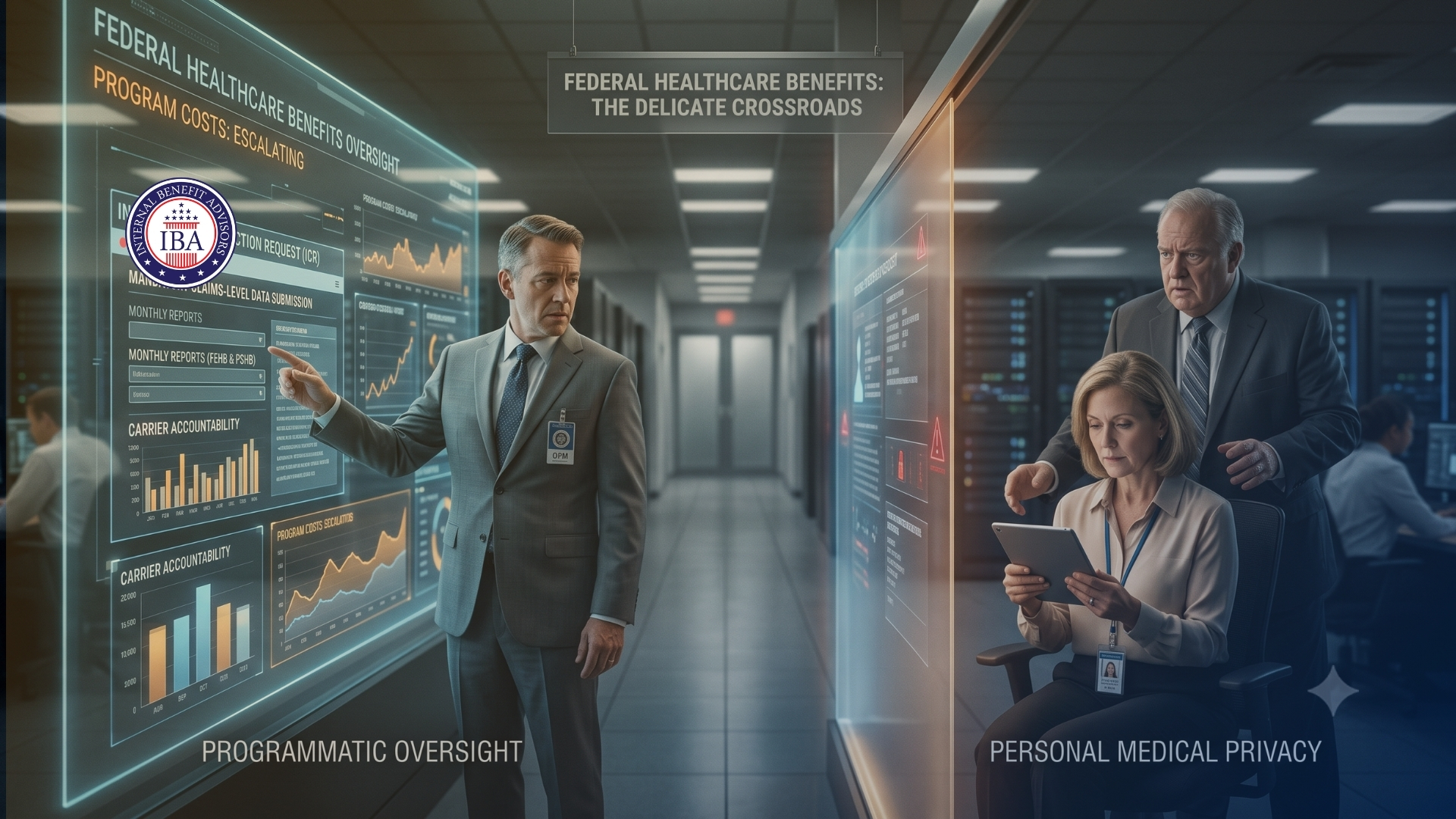

The administration of federal healthcare benefits has reached a delicate crossroads where programmatic oversight directly intersects with personal medical privacy. In an effort to curb escalating program costs and enhance carrier accountability, the U.S. Office of Personnel Management (OPM) issued an Information Collection Request (ICR) requiring insurance carriers to submit detailed, monthly claims-level data for participants in both the Federal Employees Health Benefits (FEHB) and the Postal Service Health Benefits (PSHB) programs.
The sheer scope of the requested data immediately triggered intense privacy alarms from federal employee unions, retiree associations, and congressional lawmakers. In response, OPM leadership recently stepped forward to allay these concerns, detailing internal data-masking protocols designed to anonymize participant records.
However, for the millions of public servants and annuitants whose protected health information (PHI) is on the line, evaluating this development requires looking past informal public reassurances to examine the binding legal guardrails that govern federal records.
The Scope of the Data Collection Mandate
The controversy stems from a regulatory notice published in the Federal Register directing the 65 participating health insurance carriers to provide central regulators with comprehensive monthly service use and cost reports.
The FEHB and PSHB ecosystems collectively provide medical coverage for roughly 8.3 million Americans—encompassing active federal civilian personnel, U.S. Postal Service workers, military technicians, retired annuitants, and their qualified dependents. Under the plain text of the initial notice, carriers were instructed to transfer extensive medical portfolios, including:
- Detailed inpatient and outpatient medical claims
- Pharmacy prescription fulfillment histories
- Provider clinical encounter data
- Quarterly drug manufacturer rebate figures
To justify the mandatory extraction of individual care histories, OPM cited the statutory health oversight exception within the Health Insurance Portability and Accountability Act (HIPAA), codified under 45 CFR § 164.512(d)(1). This provision permits covered entities to disclose protected health information to a duly authorized health oversight agency without individual patient authorization for authorized programmatic audits and financial evaluations.
Adding Sound Data: The Legal and Cybersecurity Context
To fully understand why employee advocacy groups like the National Active and Retired Federal Employees Association (NARFE) and the American Federation of Government Employees (AFGE) pushed back so aggressively, we must examine the broader operational and historical data surrounding OPM data management:
- The Minimum Necessary Standard: Under HIPAA’s foundational privacy rules (45 CFR § 164.502(b)), agencies requesting PHI are legally obligated to limit their collection to the “minimum necessary” required to accomplish the intended administrative purpose. Industry health organizations representing FEHB carriers argued that demanding unredacted, monthly claims data for 8.3 million individuals wildly exceeds the standard required for routine financial oversight.
- The Fiscal Catalyst: OPM’s aggressive push for data capture is driven by severe financial realities. Independent audits estimate that outdated, fraudulent, or improper dependent enrollments quietly siphon up to $1 billion annually from federal health programs. Centralized claims tracking is viewed by regulators as the most efficient mechanism to identify double-billing and flag ineligible dependents.
- Historical Breach Precedent: Federal personnel maintain a heightened sensitivity to central database consolidation due to institutional history. In 2015, OPM suffered two catastrophic cybersecurity breaches that compromised the highly sensitive background investigation records and personal identifiers of 4.2 million federal personnel and over 22 million total citizens. Opponents argue that aggregating complete medical profiles and prescription histories into a singular government repository constructs a prime target for foreign state-sponsored cyber intrusions.
Public Reassurance vs. Binding Policy
Faced with mounting pressure from labor coalitions and lawmakers, OPM Director Scott Kupor published an official response seeking to reassure participants. Kupor stated that the agency has engineered strict internal de-identification filters to ensure raw medical histories never reach standard human resource folders.
According to OPM’s clarified operational blueprint, raw carrier data will land exclusively inside the secure infrastructure of the Office of the Inspector General (OIG). The OIG will programmatically strip direct personal identifiers before pushing the analytical files to OPM program managers.
| Data Element | Initial ICR Notice Specification | Director Kupor’s Stated Safeguards |
| Direct Identifiers | Permitted under HIPAA oversight exception | Stripped by OIG (Names, SSNs, Addresses) |
| Member Tracking | Unmasked claims-level tracking numbers | Replaced with a scrambled, anonymized ID |
| Geographic Data | Full unredacted provider & patient records | Restricted strictly to the 5-digit ZIP code |
| Demographics | Full unredacted dates of birth | Limited strictly to the participant’s birth year |
| Enforceability | Codified in the Federal Register | Uncodified public policy statement |
While Director Kupor’s technical explanation provides a logical framework for anonymization, labor associations immediately highlighted a profound procedural flaw. As NARFE leadership explicitly pointed out: “A blog post is not a binding rule.”
Informal statements, press releases, and web postings carry zero legal weight in a court of law. If an agency alters its internal masking scripts or expands its data queries in future administrations, participants have no statutory recourse if the privacy protections were never formally codified in the operative Federal Register regulations or carrier contracts.
Workplace Ramifications for Public Servants
For the career civil servant, the potential uninhibited flow of medical data introduces severe career anxieties. When an administration pursues specific policy agendas regarding restricted medical procedures, reproductive healthcare, or specialized mental health treatments, employees reasonably fear mission creep.
If nominally anonymized claims data containing a unique ZIP code, birth year, and rare medical diagnosis is cross-referenced with internal agency staffing layouts, re-identification becomes a mathematical reality. Public servants should never have to wonder whether seeking confidential clinical care could eventually intersect with ongoing suitability reviews, security clearance adjudications, or localized Reductions in Force (RIFs).
Insulate Your Benefits With Specialized Advisory Support
In an era where central regulatory authorities are expanding their digital reach and traditional privacy guardrails are actively contested, you cannot rely on automated agency portals or uncodified administrative promises to protect your household. Navigating the complexities of federal healthcare compliance, maintaining life insurance continuity, and structuring a secure retirement demands objective, uncompromised expertise.
This is where dedicated assistance becomes vital. Internal Benefit Advisors provides comprehensive financial education, life insurance structuring, tax mitigation guidance, and holistic retirement planning structured explicitly for federal, postal, and state employees.
Whether you need to audit your Electronic Official Personnel Folder (eOPF) to ensure your dependent records are unassailable, evaluate your FEHB/PSHB plan structures ahead of compliance reviews, or construct a resilient retirement transition strategy that insulates your family from broader institutional volatility, working with an experienced advisor puts you entirely in control. Visit Internal Benefit Advisors today to take definitive ownership of your federal benefits package.
References
- Office of Personnel Management (OPM). (2025). Federal Employees Health Benefits (FEHB) and Postal Service Health Benefits (PSHB) Programs Service Use and Cost Data Information Collection Request. Federal Register Notice (90 FR 76541).
- U.S. Department of Health and Human Services. Standard for Uses and Disclosures: Minimum Necessary. Codified at 45 CFR § 164.502(b).
- FedWeek. (2026). OPM Responds to Concerns Over Plan to Access to FEHB/PSHB Medical Records. https://www.fedweek.com/fedweek/opm-responds-to-concerns-over-plan-to-access-to-fehb-pshb-medical-records/
- U.S. Senate. (2026). Congressional Inquiry Letter from Senators Adam Schiff and Mark Warner to OPM Director Scott Kupor Regarding Carrier Data Access. Washington, D.C.
- National Active and Retired Federal Employees Association (NARFE). (2026). OPM Plan to Access Medical Records Gets Pushback. NARFE Legislative Insights. https://www.narfe.org/
- Internal Benefit Advisors LLC. Retirement Planning Support and Benefits Package Education for State and Federal Employees. https://internalbenefitadvisors.com
Who’s Reading Your Medical Records?
This legal commentary breaks down the specific protected health information OPM is seeking from insurance carriers and analyzes the practical privacy risks facing federal employees.