
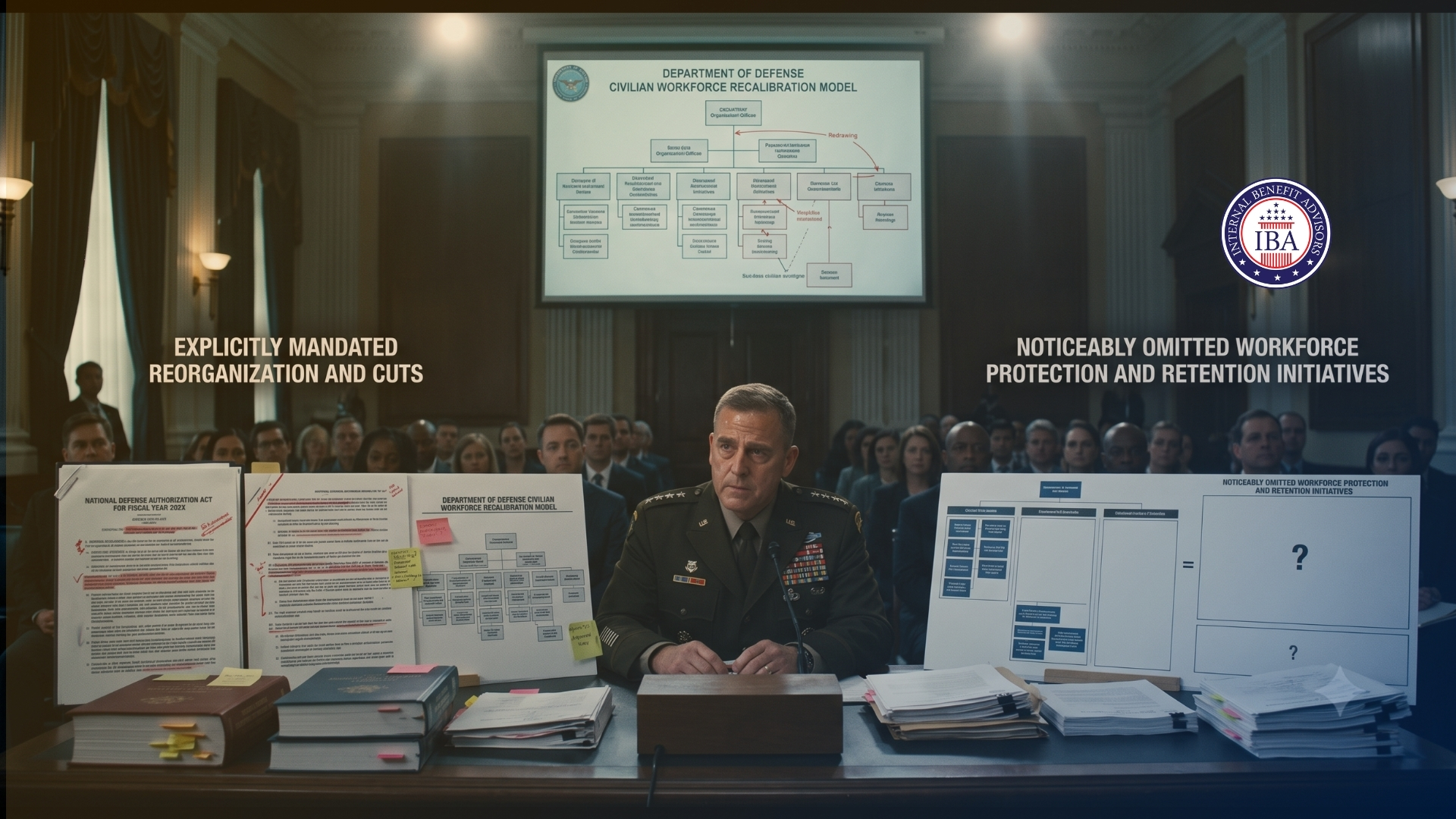

The legislative machinery governing the Department of Defense (DOD) and its massive civilian workforce is undergoing a complex structural recalibration. As Congress advances its annual defense authorization and appropriations measures, the overarching themes impacting the federal workforce are defined by what is explicitly mandated—and what is noticeably omitted.
Recent analysis highlights two distinct tracks in the Senate’s defense spending strategy. First, the upper chamber has remained noticeably silent on expanding statutory union rights or establishing new collective bargaining mandates across defense sub-components. Second, the legislation moves to baseline and protect civilian staffing levels within the critical Defense Working Capital Funds (DWCF).
For the dedicated defense professional navigating an era of macro-level human capital adjustments, understanding how these legislative choices intersect with your career stability, base pay, and long-term retirement planning is essential.
The Legislative Landscape: Union Rights Omitted
In recent legislative cycles, federal employee unions and labor advocates heavily lobbied congressional committees to insert protective labor riders into must-pass defense spending bills. These proposals aimed to insulate the civilian workforce from arbitrary reorganizations, mandate expanded official time for union representatives, and secure statutory protections against executive reclassifications (such as excepted service Schedule F transitions).
However, the emerging Senate defense spending bills have noticeably bypassed these labor-centric provisions. By remaining mum on union rights, the committee effectively leaves existing labor-management relations frameworks intact under Title 5 of the U.S. Code.
For the career civil servant, this legislative silence signals that your primary defense against workplace volatility will not come from expanded statutory union powers. Instead, career continuity will rely strictly on your individual performance evaluations, classification series, and accumulated tenure standing.
Stabilizing the DWCF Workforce
While broader collective bargaining mandates were sidelined, the Senate spending framework took a decisive step to protect the core infrastructure of the military’s logistical and maintenance backbone: the Defense Working Capital Funds.
Operating as self-sustaining financial entities, DWCF activities—including Naval shipyards, Army depots, Air Force logistics centers, and the Defense Logistics Agency (DLA)—rely on revolving funds generated by charging military customers for repairs, parts, and industrial services.
Historically, when broader agency downscalings or hiring freezes occurred, DWCF facilities often suffered collateral damage, forcing administrative furloughs or arbitrary reductions in full-time equivalent (FTE) levels that disrupted complex maintenance schedules. The Senate spending framework moves to explicitly baseline DWCF civilian levels, shielding these specialized industrial and logistical workers from arbitrary headcount drawdowns.
DOD Workforce Legislative Tracks
┌───────────────────────────────┬────────────────────────────────┐
│ UNION / LABOR RIGHTS │ DWCF STAFFING LEVELS │
├───────────────────────────────┼────────────────────────────────┤
│ Omitted from Senate Spending │ Maintained at Current Baselines│
│ Relies on Existing Title 5 Law│ Insulated from Hiring Freezes │
│ Performance Appraisals Vital │ Protects Industrial Operations │
└───────────────────────────────┴────────────────────────────────┘
Adding Sound Data: The Broader Contraction Context
To fully appreciate why stabilizing DWCF staffing levels is a major legislative victory, we must examine the contrasting personnel metrics across the remainder of the Department of Defense.
Outside of the protected DWCF industrial bases, the Pentagon’s baseline civilian workforce has absorbed massive reductions over the last 12 months:
- Total DOD Contraction: The Pentagon successfully downscaled its broader civilian headcount by over 78,000 employees (a roughly 10 percent net reduction).
- Hiring Freeze Deficits: Institutional onboarding restrictions resulted in 59,500 fewer civilian personnel entering the defense ecosystem compared to historical baselines.
- Resignation Outflows: Over 53,200 defense personnel officially exited active service via government-wide Deferred Resignation Programs (DRP).
- Industrial Backlogs: Before the staffing baselines were established, arbitrary civilian caps at major maintenance depots contributed to hundreds of millions of dollars in deferred maintenance backlogs across the Pacific and Atlantic fleets.
By locking in DWCF civilian levels, Congress is drawing a clear line in the sand: institutional drawdowns cannot compromise the direct operational lethality and maintenance readiness of the armed forces.
Downstream Impacts on Your Federal Benefits Folder
Whether you are a protected DWCF artisan at a naval shipyard or a competitive service analyst at the Pentagon navigating unannounced reorganizations, shifting legislative mandates directly impact your personal wealth accumulation.
When institutional rules and organizational footprints evolve rapidly, you must pay close attention to the structural mechanics of your benefits:
High-3 Salary Calculations
Your lifetime Federal Employees Retirement System (FERS) pension is anchored directly to your “High-3” average salary. If an uncoordinated reorganization or localized reduction forces an unexpected demotion or re-assignment, your peak earning potential can plateau, permanently suppressing your future annuity payouts.
Thrift Savings Plan (TSP) Compounding
Staying fully employed and maximizing your basic elective deferrals (up to $24,500 pre-tax or Roth) ensures you continuously capture the mandatory Agency Automatic 1% Contribution and the full 4% Agency Matching funds. An administrative pause or forced separation immediately halts this growth engine.
Health Continuity (FEHB)
Carrying your Federal Employees Health Benefits into retirement requires maintaining continuous coverage under an established plan for the five calendar years immediately preceding your statutory retirement date. Navigating career transitions without disrupting this five-year continuous coverage clock is critical to avoiding catastrophic out-of-pocket medical liabilities in retirement.
Insulate Your Career With Internal Benefit Advisors
In an operational environment where major spending bills omit expanded labor rights and workforce rules are actively shifting, you cannot leave your personal retirement readiness to chance. Automated portals and backlogged agency human resources offices cannot provide the tailored, objective verification your family needs.
This is where dedicated support becomes vital. Internal Benefit Advisors provides comprehensive financial education, life insurance analysis, tax strategy optimization, and tailored retirement planning structured explicitly for federal, defense, postal, and state employees.
Whether you need to project your FERS pension in the face of localized DOD restructuring, optimize your TSP asset allocations to protect against market volatility, or audit your lifetime Standard Form 50 (SF-50) history to ensure your High-3 calculations are unassailable, working with an experienced advisor puts you entirely in control. Visit Internal Benefit Advisors today to take definitive ownership of your federal benefits package and build a fully secure transition into retirement.
References
- U.S. Senate Committee on Armed Services. (2026). National Defense Authorization Act for Fiscal Year 2027: Committee Funding Tables and DWCF Operational Baselines. Washington, D.C. https://www.armed-services.senate.gov/
- U.S. Code. Defense Working Capital Funds. Codified at 10 U.S.C. § 2208.
- FedWeek. (2026). Senate Defense Spending Bill Mum on Union Rights; Would Maintain DWCF Civilian Levels. https://www.fedweek.com/
- Government Accountability Office (GAO). (2026). Defense Working Capital Funds: Actions Needed to Improve Staffing and Reduce Maintenance Backlogs (Report Number GAO-26-108992). Washington, D.C. https://www.gao.gov/
- Congressional Research Service (CRS). (2026). Defense Primer: The Defense Working Capital Fund. https://crsreports.congress.gov/
- Internal Benefit Advisors LLC. Retirement Planning Support and Benefits Package Education for State and Federal Employees. https://internalbenefitadvisors.com