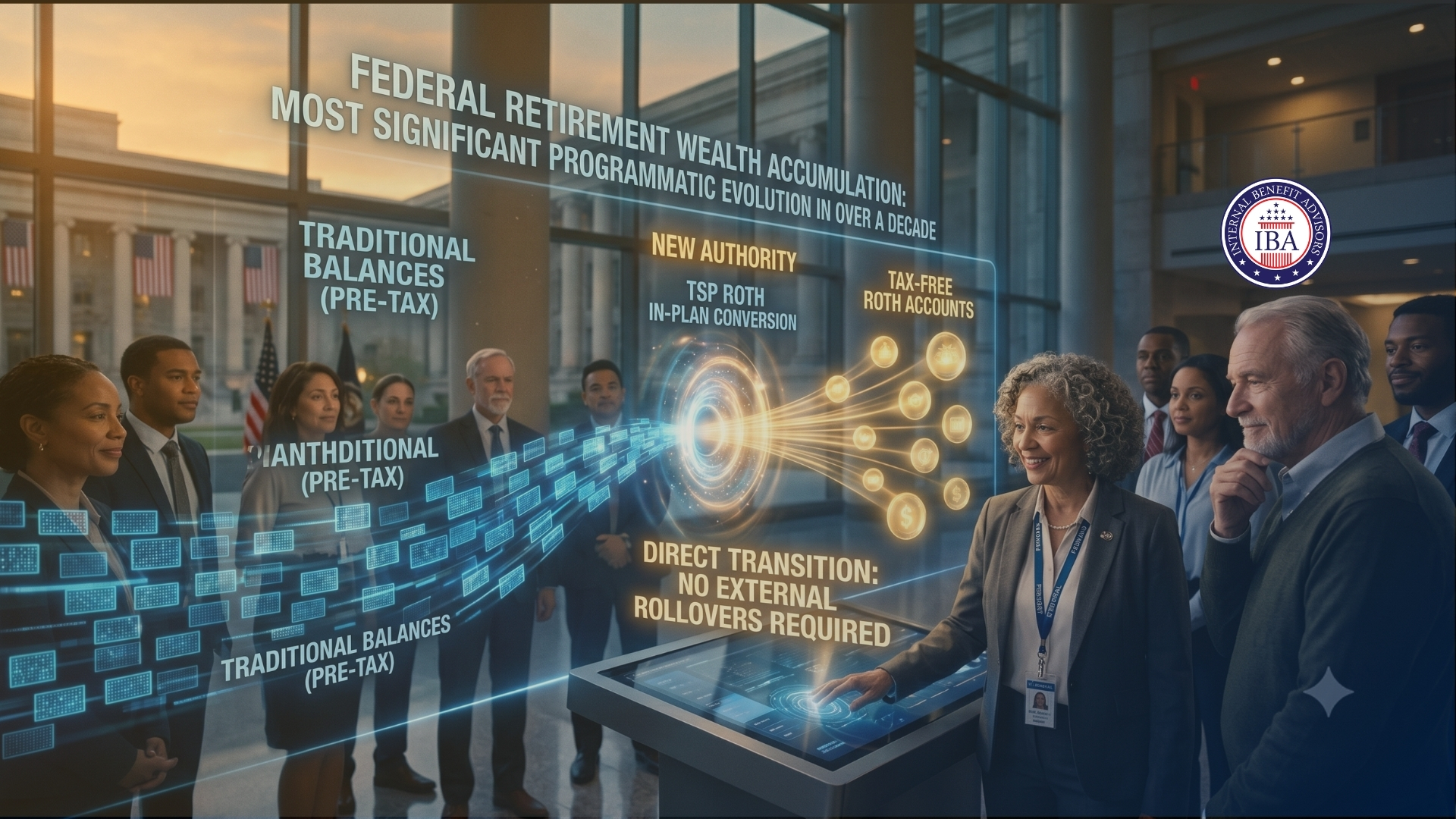

The structural rules governing federal retirement wealth accumulation have undergone their most significant programmatic evolution in over a decade. With the official rollout of the Thrift Savings Plan (TSP) Roth In-Plan Conversion option, federal employees and retirees finally possess the authority to transition existing traditional, pre-tax balances directly into tax-free Roth accounts without executing external plan rollovers.
The implementation of this feature has triggered an immediate, high-volume migration of retirement assets. Internal tracking data from the Federal Retirement Thrift Investment Board (FRTIB) confirms that early adopters have already converted nearly $700 million from traditional TSP allocations into Roth holdings within the opening months of the program’s activation.
While this rapid shift signals massive enthusiasm for lifetime tax mitigation, navigating an in-plan conversion introduces intricate tax liabilities and structural rules that demand meticulous, proactive planning.
Inside the Numbers: The Capital Wave Heading Into Roth
The $700 million wave of early conversions underscores a profound shift in how public servants view their long-term tax exposure. Historically, federal personnel were locked into whatever contribution pathway they initially selected; once money entered a traditional pre-tax account, it remained subject to ordinary income tax upon withdrawal.
The new policy framework allows active federal civilian employees, uniformed service members, separated participants, and spousal beneficiaries to execute up to 26 conversions per account per calendar year. This frequency matches the standard biweekly federal pay cycle, granting personnel the unique flexibility to execute systematic, incremental conversions (“Roth laddering”) rather than absorbing a massive tax hit all at once.
TSP Roth In-Plan Conversion Parameters
┌───────────────────────────────┬────────────────────────────────┐
│ OPERATIONAL COMPONENT │ REGULATORY STANDARD │
├───────────────────────────────┼────────────────────────────────┤
│ Minimum Conversion Threshold │ $500 Per Request │
│ Account Retention Requirement │ $500 Left Behind Per Source │
│ Annual Frequency Limit │ Max 26 Conversions Per Year │
│ Transaction Reversibility │ Strictly Permanent (No Undo) │
│ Processing Speed │ Next-Day Market Close Settlement│
└───────────────────────────────┴────────────────────────────────┘
However, the FRTIB’s data reveals a critical operational boundary: conversions must be processed on a strict pro rata basis across all available traditional payroll sources—including personal pre-tax contributions, Agency Automatic 1% Contributions, and matching funds. Participants cannot cherry-pick specific buckets; the system proportionally sweeps funds across every eligible pre-tax source inside the account.
The Tax Trade-Off: High Short-Term Costs for Lifetime Tax Immunity
The primary driver behind the $700 million migration is the desire for long-term tax control, but the upfront financial hurdle is steep. When a participant converts traditional TSP assets to a Roth balance, the entire converted amount is treated as ordinary taxable income in the year the transaction occurs.
For example, a mid-career professional moving a $50,000 traditional balance into a Roth account while sitting firmly in the 22% federal tax bracket will generate an immediate $11,000 federal tax liability, plus applicable state and local taxes.
The Mechanics of an In-Plan Conversion Tax Hit
Traditional TSP Balance ──► [ Conversion Event ] ──► Added to Current Year Gross Income
(Pre-Tax) (Taxed as Ordinary Income)
│
Tax Paid via OUTSIDE Cash Reserves ◄────────────────────────────────┘
A critical regulatory mandate states that participants cannot use a portion of the converted TSP funds to pay the tax bill. The full transaction amount must land intact inside the Roth account, meaning the employee must possess sufficient, liquid cash reserves outside of the retirement system to settle the tax liability with the IRS. Attempting to withhold taxes directly from the retirement asset account can trigger an immediate 10% early withdrawal penalty for individuals under age 59½.
Strategic Advantages: Why Federal Personnel are Converting
Despite the immediate cash outflow required to cover the tax bill, strategic financial analysis confirms that the long-term mathematical advantages are compelling for specific career timelines.
- Permanently Eliminating Required Minimum Distributions (RMDs): Traditional TSP balances legally force retirees to begin taking taxable distributions at age 73 or 75, depending on their birth year. Roth TSP balances are entirely exempt from RMDs, giving retirees absolute authority over when and how they draw down their wealth.
- Insulating Post-Service Income from Bracket Creep: A common blind spot for federal retirees is the “triple tax threat” of a FERS annuity, Social Security benefits, and traditional TSP distributions hitting their tax return simultaneously. Converting to Roth now eliminates the TSP portion from future gross income calculations, preventing retirees from being unexpectedly pushed into higher brackets.
- Mitigating Medicare Surcharge Penalties (IRMAA): Because qualified Roth TSP withdrawals do not count toward Modified Adjusted Gross Income (MAGI), strategic conversions protect retirees from triggering costly Income-Related Monthly Adjustment Amount (IRMAA) surcharges on Medicare Part B and Part D premiums.
Avoiding the Permanent Trap: The Five-Year Rules
The most dangerous pitfall facing early adopters is the absolute permanence of the transaction. Under current IRS regulations, a Roth in-plan conversion cannot be reversed or undone. Once the digital signature is submitted in My Account, the tax liability is locked in.
Furthermore, conversions are bound by two separate, parallel five-year rules that govern distributions:
- The Principal Access Rule: Each distinct conversion transaction starts its own five-year clock. If an employee accesses converted principal before satisfying this window, they can face a 10% early withdrawal penalty if they are under age 59½.
- The Earnings Tax-Free Rule: To pull the investment growth out of the Roth TSP entirely tax-free, the account holder must be at least age 59½ AND the overall Roth account must have been established for at least five calendar years.
Aligning Your Conversion with Comprehensive Advisory Support
The $700 million migration proves that federal employees recognize the power of the Roth ecosystem, but execution without an integrated tax strategy can result in a catastrophic, unintended tax bill that pushes you into a higher marginal bracket. Isolating the ideal conversion window requires looking past your basic account balance to analyze your current salary tier, expected pension metrics, and liquid emergency reserves.
This is where specialized, external guidance becomes indispensable. Internal Benefit Advisors provides comprehensive financial education, tax strategy optimization, life insurance restructuring, and holistic retirement planning tailored specifically for federal, postal, and state employees.
Whether you need to design a systematic multi-year Roth laddering strategy that stays below higher tax brackets, analyze your current cash reserves to see if you can afford the conversion tax, or project your future FERS annuity layout alongside your TSP goals, working with a specialized advisor ensures your retirement transition remains insulated, highly optimized, and entirely under your control.
References
- Federal Retirement Thrift Investment Board (FRTIB). (2026). Thrift Savings Plan Bulletin 25-4: Launch of Roth In-Plan Conversion Feature for TSP Participants and Beneficiaries. Codified at 5 CFR Part 1690. https://www.tsp.gov/bulletins/25-4/
- Office of Personnel Management & FRTIB. (2026). Federal Register Rules and Regulations: Roth In-Plan Conversions. 5 CFR Part 351 (91 FR 1668, Document Number 2026-00765). https://www.federalregister.gov/documents/2026/01/15/2026-00765/roth-in-plan-conversions
- FedWeek. (2026). Early Adopters Kick Off TSP Roth In-Plan Conversion Option with Shift of Nearly $700 Million. https://www.fedweek.com/fedweek/early-adopters-kick-off-tsp-roth-in-plan-conversion-option-with-shift-of-nearly-700-million/
- Thrift Savings Plan Official Portal. (2026). Roth In-Plan Conversions and Tax Calculator Resources. https://www.tsp.gov/investing-strategies/roth-in-plan-conversions/
- Internal Benefit Advisors LLC. Retirement Planning Support and Benefits Package Education for State and Federal Employees. https://internalbenefitadvisors.com