
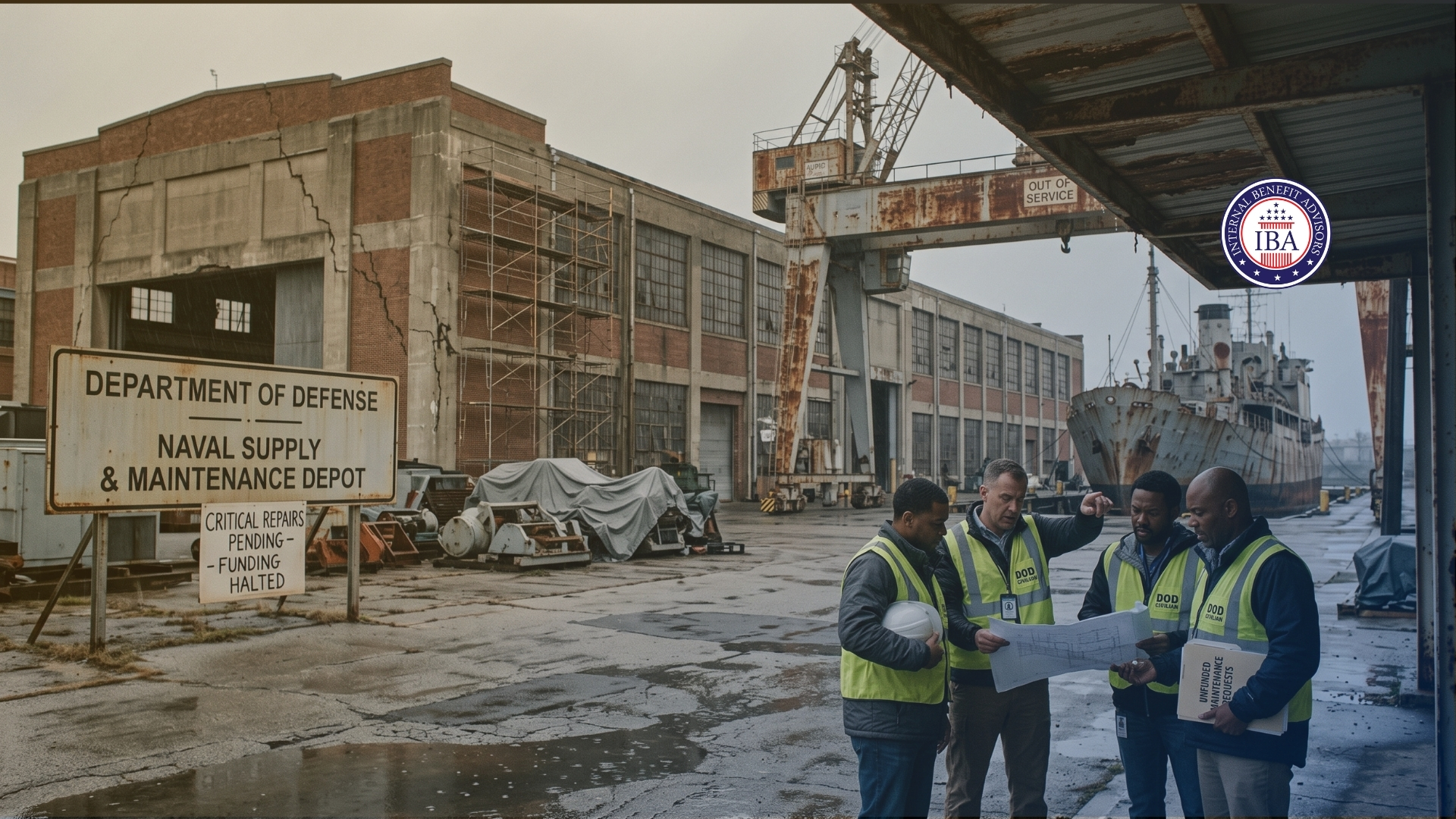

The physical and administrative infrastructure of the United States military is experiencing severe, compounding degradation. For the civilian workforce operating within the Department of Defense (DoD) and the Department of War (DoW), the push to dramatically contract the federal payroll has collided with a massive, unfunded maintenance crisis.
According to a recent Government Accountability Office (GAO) report and coverage by FEDweek, the backlog of deferred maintenance at defense facilities has skyrocketed to a staggering $385 billion. Base officials explicitly informed auditors that the combination of the Deferred Resignation Program (DRP) and strict hiring freezes has gutted their facility management offices, leaving them structurally unable to maintain safe, operational installations.
For the career civil servants left behind to manage this crisis, the reality is stark: they are being asked to do exponentially more work in physically decaying, under-resourced, and potentially hazardous environments. Navigating this unsustainable operational tempo requires federal professionals to establish a highly defensive, independent financial and retirement strategy.
Sound Data: Deconstructing the GAO’s Maintenance Warning
To understand the sheer magnitude of the crisis facing the civilian defense workforce, one must look at the specific empirical data highlighted by the GAO and the underlying administrative policies driving the deficit:
- The 181 Percent Surge: The financial weight of the maintenance backlog is growing at an unsustainable rate. The GAO estimates that deferred maintenance at DoD/DoW facilities surged from $137 billion in 2020 to $385 billion today.
- The Eradication of Billets: The staffing shortage is not temporary. Officials reported to the GAO that positions previously held by individuals who participated in the Deferred Resignation Program were permanently eliminated from their offices, regardless of the ongoing operational need for those roles.
- The 46 Percent Vacuum: The localized impact of these policies is devastating. At Little Rock Air Force Base in Arkansas, for example, officials reported losing approximately 46 percent of their baseline workforce availability for facility maintenance.
- The Funding Deficit: Even with a reduced workforce, the remaining staff lacks the capital to execute repairs. None of the eight installations visited by the GAO received funding that met the DoD’s goal of 90 percent sustainment. At Andersen Air Force Base in Guam and Minot Air Force Base in North Dakota, sustainment funding hovered around a dismal 40 percent between 2021 and 2025.
The True Cost of Hazardous Facilities (Additional Data)
The GAO report notes that auditors found severe facility conditions during their visits, including inoperable fire safety systems, severe roof leaks, asbestos hazards, flash flooding, and pervasive mold and mildew.
Working in these decaying environments carries a steep, hidden cost for the civilian workforce. According to the Occupational Safety and Health Administration (OSHA) and the Environmental Protection Agency (EPA), prolonged occupational exposure to toxic mold and friable asbestos drastically increases the risk of chronic respiratory illnesses, asthma, and severe long-term health complications. When the hiring freeze prevents the recruitment of specialized maintenance technicians and design engineers, the health and safety of the broader civilian and military workforce occupying these buildings is directly jeopardized.
Furthermore, the strategic readiness of the military is compromised. A failure to maintain HVAC systems, secure foundations, and fire suppression protocols places billions of dollars of highly sensitive military hardware and technology at immediate risk of environmental destruction.
Secure Your Independence with Internal Benefit Advisors
When your agency is struggling with a $385 billion maintenance deficit and administrative policies prevent the hiring of necessary support staff, relying passively on your department for career stability is a dangerous posture. You must build an independent financial perimeter that allows you to walk away from a deteriorating workplace on your own terms.
At Internal Benefit Advisors, we specialize in providing the fiduciary-level guidance federal professionals require to secure their wealth amidst severe institutional and physical restructuring:
- Strategic Exit Planning (VERA/VSIP): If the burnout of working in an understaffed, decaying facility prompts your agency to offer Voluntary Early Retirement Authority (VERA) or buyout packages (VSIP) as part of further restructuring, we provide the exact mathematical projections you need. We calculate precisely how an accelerated exit will impact your High-3 average salary and your lifetime FERS or CSRS annuity check.
- FERS Disability Retirement Projections: If chronic exposure to hazardous facility conditions (such as mold or asbestos) permanently impacts your health and your ability to work, standard retirement may not be your best path. We provide exact mathematical projections on how a FERS Disability Retirement would impact your income, allowing you to transition out of a dangerous environment with guaranteed financial security.
- Defensive TSP Optimization: A highly volatile, under-resourced workplace requires an actively protected financial posture. We offer expert counseling on your Thrift Savings Plan (TSP) allocations to shield your capital from market volatility, ensuring your wealth remains secure and growing, entirely independent of your agency’s operating status.
- Complimentary Retirement Paperwork Processing: Do not face the notoriously backlogged OPM system alone. Our team comprehensively audits and completes your retirement paperwork for FREE, ensuring a flawless application that prevents agonizing processing delays in your interim pay.
Take Command of Your Financial Trajectory
The GAO report proves that the DoD and DoW civilian workforce is currently bearing the brunt of massive budgetary and administrative cutbacks. While you cannot control the hiring freezes, the eradication of maintenance billets, or the physical state of your installation, you have absolute authority over your personal financial readiness.
Take command of your career transition today. Contact the experts at Internal Benefit Advisors for a Free Benefit Assessment and ensure your hard-earned wealth remains completely secure, regardless of the climate at your agency.
References
- FEDweek. Deferred Maintenance Up, Needed Staff Down, DoD/DoW Officials Tell GAO. FEDweek.com
- Internal Benefit Advisors. Information you need, Support you can trust. InternalBenefitAdvisors.com
- Government Accountability Office (GAO). Defense Infrastructure: Actions Needed to Better Manage Facility Sustainment.
- Occupational Safety and Health Administration (OSHA). Indoor Air Quality in Commercial and Institutional Buildings.