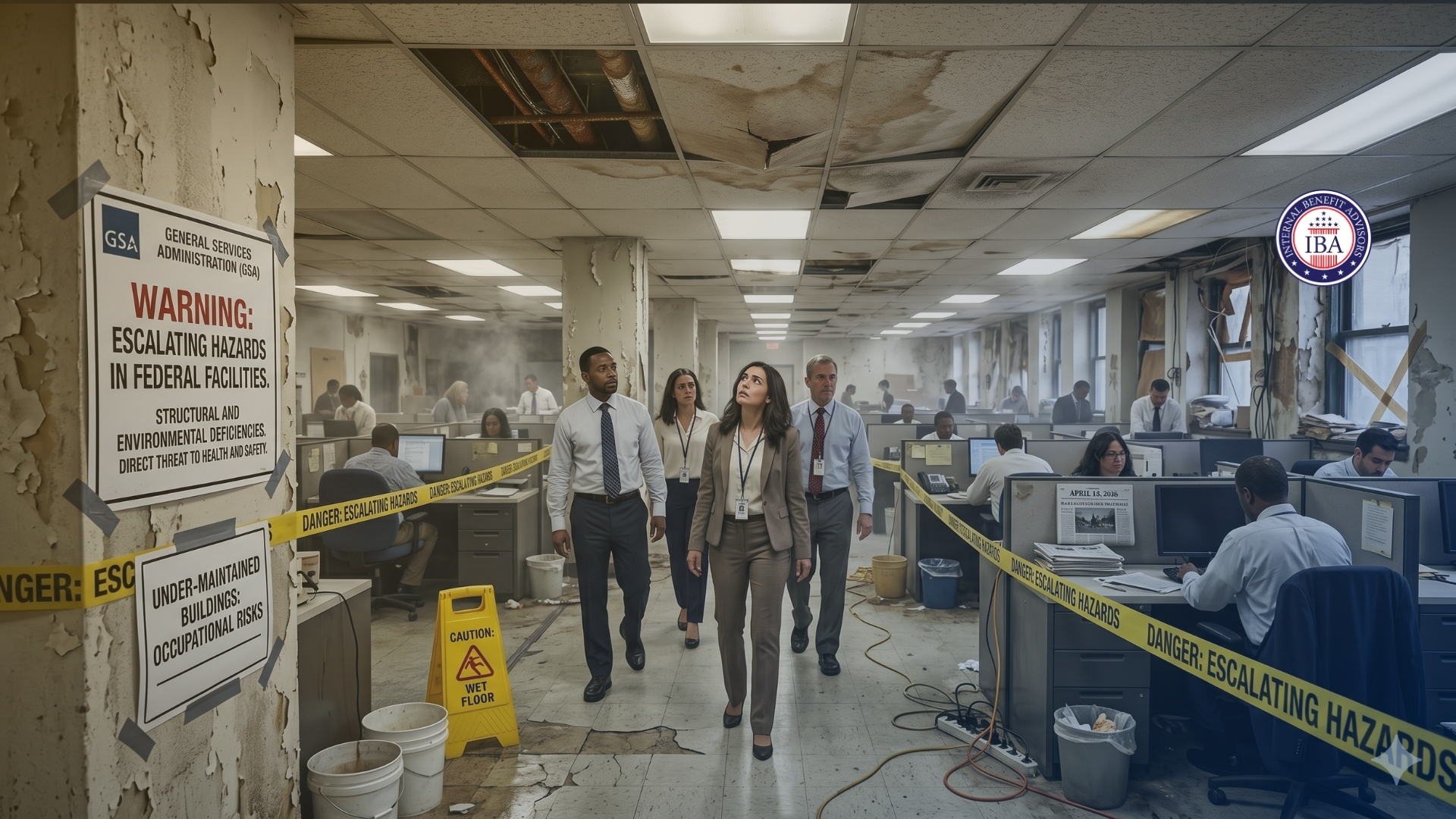

The physical environment of the federal workforce is deteriorating at an alarming rate. According to recent warnings from the General Services Administration (GSA), hazards within under-maintained federal buildings are rapidly escalating. For the thousands of civil servants who report to these facilities daily, the growing list of structural and environmental deficiencies is no longer just a bureaucratic budget issue—it is a direct threat to occupational health, safety, and long-term career planning.
While discussions of federal employment often center around pay scales, benefits, and policy shifts, the physical safety of the workplace is a foundational requirement. When an agency’s infrastructure fails, the burden is inevitably carried by the employees.
The Scope of the Crisis: Sound Data on Deferred Maintenance
The GSA’s warning is not an exaggeration; it is backed by stark financial and structural realities. Decades of chronic underfunding and deferred maintenance have created a critical mass of infrastructure liabilities.
Consider the concrete data driving this crisis:
- The Multi-Billion Dollar Backlog: Recent federal budget requests and Government Accountability Office (GAO) reports indicate that the GSA is facing a deferred maintenance and repair backlog that exceeds $3.4 billion. This liability spans across roughly 1,500 federally owned assets.
- Critical System Failures: The “rapidly escalating” hazards identified by the GSA are not cosmetic. They involve end-of-life failures in critical building systems, including outdated HVAC units that compromise indoor air quality, persistent water intrusion leading to mold proliferation, deteriorating fire safety systems, and electrical risks.
- The Funding Gap: The Federal Buildings Fund (FBF), which is designed to collect rent from tenant agencies to fund repairs, routinely operates at a deficit compared to the actual cost of needed capital improvements, leaving the GSA unable to keep pace with the degradation of aging facilities.
The Impact on Your Career and Health
Working in an environment plagued by unresolved maintenance hazards takes a profound physical and psychological toll. Poor air quality, temperature extremes due to failing HVAC systems, and the constant underlying stress of physical risks contribute heavily to workforce burnout.
Furthermore, these conditions can lead to severe, long-term health complications. If the physical state of your agency’s building is degrading your quality of life or threatening your health, it often forces a reevaluation of your career timeline. Federal employees in these environments frequently find themselves weighing the cost of staying until their planned retirement age against the immediate need to exit a hazardous workspace.
Protecting Your Future with Internal Benefit Advisors
You cannot control the appropriations process that funds building maintenance, but you have absolute control over your financial exit strategy. When institutional support falters—right down to the safety of the building you work in—relying on a highly optimized, independently managed financial plan is your strongest defense.
Internal Benefit Advisors provides the fiduciary-level guidance necessary to help you navigate these complex career decisions on your own terms. Our experts help federal professionals build a financial perimeter that allows them to prioritize their health and safety:
- Accelerating Your Exit Strategy: If unsafe working conditions prompt you to leave federal service earlier than planned, we help you calculate the exact financial impact. We evaluate your eligibility for early retirement and ensure you understand how an accelerated timeline affects your High-3 average and lifetime annuity.
- Free Retirement Paperwork Assistance: Navigating a stressful work environment is difficult enough without the added burden of complex administrative forms. If you choose to retire, we audit and complete your FERS or CSRS paperwork for FREE, ensuring your application avoids OPM processing delays.
- Maximizing FEHB and FEGLI: In environments with elevated health risks, your safety nets are critical. We provide comprehensive reviews of your Federal Employees Health Benefits (FEHB) and Federal Employees’ Group Life Insurance (FEGLI) to guarantee your coverage is optimized for your current risks and smoothly transitions with you into retirement.
- TSP and Financial Continuity: Leaving an agency unexpectedly requires a defensive financial posture. We provide expert counseling on your Thrift Savings Plan (TSP) allocations, ensuring your capital is protected and accessible when you need it most.
Secure Your Independence
The escalating hazards in under-maintained federal buildings serve as a stark reminder that federal employees must be their own strongest advocates. Do not wait for a structural failure or a health crisis to finalize your retirement strategy.
Take command of your financial readiness today. Contact the experts at Internal Benefit Advisors for a Free Benefit Assessment and ensure your hard-earned benefits are structured to provide you with the freedom to leave a hazardous environment whenever you choose.
References
- FEDweek. GSA Says Hazards in Under-Maintained Buildings ‘Rapidly Escalating’. FEDweek.com
- Internal Benefit Advisors. Benefits Simplified, Retirement Maximized. InternalBenefitAdvisors.com
- General Services Administration (GSA). Congressional Budget Justifications and Federal Buildings Fund Data.
- U.S. Government Accountability Office (GAO). Federal Real Property: GSA Needs to Improve the Reliability of Its Deferred Maintenance Data.